Friday, September 23, 2005

THE WOLF SPIDER BLUES


These cool spiders are quick and hard to photograph. The slightest movement makes
them run and they don't stop until you can't see them and they are four or five feet
away. I either have had to catch or use a super-teli-macro lens which can catch shots
like this from four feet away to get pictures of them. But recently I tried even more
waiting and approaches. The problem with this was there are so many of them I feared
I was stepping on them and killing the very thing I admire. So I got really lucky when
a hordes of them seemed to hypnotize each other and this shot was possible. They do not
hunt or eat each other to my knowledge and 100s and 100s can often populate a small back
yard here. (Not easy to setup). Wolf spiders are rare in that they actually carry there
young as well, the mother carries her egg sack and then young until they are older on her
back. And incredible show of parental ability and a study in “spider sociability” they
are not true communal species but I’ve found 100s of them in the same area of differing
sizes and ages leading me to believe they tolerate each other and avoid most dangerous
conflict. They would have too or there would just be a few “kings of the hills” in my back
yard. This one was a lucky shot I pulled off during some yard work being done on my house.
This old shirt had been used to insulate the pipes and a ton of Wolf spiders now covers
the area. Catching a picture of them is an illusive thing. I have more shots but this
is another one I'm going to have to search my database for. The general Wolf Spider's
scientific name is:
(Lycosidae) in this particular case: Lycosa gulosa.
(Forest Wolf Spider).

Tuesday, September 20, 2005

PRAYING MANTIS-CLOSE UP


This guy flew into my lights not long ago. I kept a couple of them inside
overnight because of the local cats. I took this in the morning when I realized
them. BEWARE keeping two praying mantis together in one cage will probably
result in a deadly fight. I knew this allready from when I was a kid in Hawaii.
Just as I learned they will take food but NEVER feed them human foods as
things like potato chips are deadly toxic to them. If you ever catch them to
hold them even if they seem to get along at first ALWAYS–keep them
separated.


This is the closest shot I’ve ever gotten of a praying mantis head without croping.
You can see the three possibly directional eyes between the two big ones.
I’m not certain what these simple eyes are for–but they can be seen
in bees and many other insects. I theorize that they may be an instant
way for the Insects to orient themselves while flying. Basically
often when insects are flying they cannot see what is going on past
them with there complex compound eyes. The world becomes a
blur. In order for flight orientation it makes sense to have sensors
which can orient the position of the sun (the sky) and areas that are
light and dark. This is only my theory–I wish I had my detailed anatomy
books that I used too. But it would make sense to have sensory
eyes like this which don’t focus but simply sense the present of light
and dark without overwhelming the senses as it surely must get
when flying insects are dodging plants and even each other often.
Basically, they may be a way to find the exact position of the sun.
Then again for all I know they could amount to very little.
As I note–my THEORIES are clearly marked from what I know to
be fact. Above is just a theory I will have to study up on in the
future. I will update this book when I find out–this has been
something. I”ve wanted to know for a long time. What are the
other three eyes for? Most insects clearly don’t just have two when
you look at them close up.


It’s not showing jaws now as it is not feeding or irritated and upset. Just look at the
complex mouthparts. Incredible--that would be like having 10 tongs or
something! The larger ones in Hawaii and other tropical places often get angry
and in this situation may rear up and show there mandibles–even bite. I’ve actually
had one begin to attempt to seemingly eat me alive as I held on to it for too long!

Another shot of the underside showing mantis mouth parts.


THE STARS AT CAMP


I took this picture on the California, Nevada border. The exposure time was
about 60 seconds. My CCD shutter was open for one whole minute at 400ISO.
Opening up the CCD longer reduced my view of the trees, I did a number of
pictures like this- some showing the big dipper. The stars were amazeing.
Be sure to click on this picture to see it as large as it gets on line.

Saturday, September 17, 2005

35mm crabs!


This is the famous and very common crab Flower Spider- Misumena vatia
These two pictures were taken with my 35mm Pentax using
extension tubes a couple of months ago. I believe I just used a two
of them with a 135mm lens to take these. As you can see old cameras are not
“dead”–35mm pictures like these can be put right into the digital
world. I could scan them myself–but to spare myself that difficult
and actualy more expencive proses by just have my film developed to
a CD (they scan the film to make the prints now days anyway)-any
good photo-store (even like Fred Mayers) should have the option
and will get the absolute most out of your pictures producing 2-5mb+
JPEG files (you could of corse ask for RAW or other modes if you want).
You get a picture that is somewhere between a very nice 3.2mp
(a $300+ 3.2mp camera) and a nice 5mp camera. Depending on
the film you use, and of corse how good your comparison 5mp and 3.2mp
test cameras sensor is. Some are better then others in fact due to optics
and other factors I’ve heard a good 4mp camera can be better then a cheap
5mp. It is all about the depth and color and thus quality of your sensor–
of corse the pixel size must be compensated for which is not difficult to do.
I’ve seen some big differences. I’m no expert but my tests put the film
mark between 3.2 and 4.5mp in JPEG depending on what kind of film
you use. There is a difference between 200-400 regular film and expensive
fine slide film wich turns out higher resolutions and better colors-I have not
tested the "high definition" films.

Friday, September 16, 2005

I GOT CRABS!

Here she is, a proud well fed crab spider. (Thomisidae) It is difficult to identify
as crab spiders can change colors slowly to blend into there environment. This
is probably not the common "Flower spider" as I first thought. It could be a
juvenile, since I have not seen enough very young crab spiders to know for sure.
Some better then these. Recently I've been consolidating and organizeing my
huge database of nearly 15,000 pictures and convert one file at a time. I also
don't want to overload my readers with tons of pictures of the same subject--so
I'm cutting down on the number of pictures I show per species even if I have
more really nice shots some won't get on my website. E-mail me if you want to
see more crab spider pictures--I got a lot of them.


This looks very much like the Xysticus triguttatus, this conclusion comes from
male crab spiders of similar size a trademark black cephalothorax identifies them.
The males are black or dark brown--there are already some pictures of the ones
I've found on this site--look under "all pictures" --that's my gallery. Click on
the dates to see most of my pictures that are on line--A LOT more then I can
fit here on this "front page" at a time.

This is very possibly the Xysticus triguttatus--not the bright white gold to yellow larger
species we also have here in The Dalles. If this is X. triguttatus, it's common name is
listed as the "Three Banded Crab spider" In that case she's fully grown or very close to
it. I don't think it's the common to Portland Flower spider or Misumena vatia. They
also live here in The Dalles but are not as easy to find here.

It is difficult not to put up the other shots I got like this that are as cool,
but I want my readers to look at the whole site and showing the same
spider over and over again is probably boring no matter what the
differences are.

If you want to see more pictures of an individual subject you can e-mail
me and I will add them. Most of the spiders and insects here were
photographed from all angles and I probably have 2-20 pictures you
won't see on my website of the same species, or the same exact subject
I just don't post--often not at all because they are not as good-I simply
have to many of them.


An Ornate Tiger Moth (Apantesis ornata), visited my lights a while back.
This is clearly a male judging by the feelers and the fact that wondering
males tend to be more attracted to lights in this species.

DON'T FORGET to see last months and before pictures to go
to "all pictures" and click on the dates--I had alot of great ones
in each month--they don't all show up here in this first "scroll"
space or page. If they did it would take hours to load my website
so I had to break them up monthly.

Thursday, September 15, 2005

HYDRO PHOTOGRAPHY

--THIS ARTICLE IS IN PROGRESS-
NOT FINISHED YET--I GOT THE FLU
AS OF 9/19/05

I am very proud of these pictures. But they were not my idea. Steve,
from "Steve's spider pics" sent me some great shots from a leaking valve in an e-mail.
Click here-> STEVE'S PICS to look at his pictures. Be sure to lator visit his spectacular
web site on spiders by clicking on the link box.

Come back to my site by clicking the back arrow key or just re-load it.


He has since added some more shots to the above link so check it out again.
He's got some nice ones done in different colors. One awesome thing about
photography is the amazing countless number of subjects, and ways there is
photograph them. Sometimes just a few feet away or in a simple moment--
you can capture lifes greatness.


I am very proud of these pictures. But they were not my idea. Steve
from "Steve's spider pics" sent me his shots from a leaking valve in an e-mail.
Click here-> Steve's shots to look at his pictures.


I'm glad Steve showed me this kind of photography can be done was great and I set about thinking. I never thought of trying stop action style water pictures or high speed bursts to catch it or anything. I took it an obvious level further and tried capturing the drops hitting in a cup. Digital makes it much more possible. I saw the pictures on the link he sent me and was so impressed in less then a couple of minuets I instantly had to jump off the computer and try it for myself. With just a few tries--I had it, and took these shots. Next time I do this shot I'm going to I might up my flash brightness and take a few more tries to get a better shot. I took these shots with three different lenses.


I really like these pictures! I took all these pictures inside my kitchen sink.
I did need a nice macro lens on my camera to begin to do this least to do this.
This one is not a crop! Although cropping is one answer for not having the
right lens on or if you want to change your picture later.

I really like these pictures! I took all these pictures inside my kitchen sink.
I did needed a few macro lenses on my camera to begin to do this least to do this.
This one is not a crop! Although cropping is one answer for not having the
right lens on or if you want to change your picture later. I'm glad I got a solid 6mp-
that allows me to crop more without loosening as much say if I used a 4mp
camera. It also has the critical feature of having no restrictions. You can take a picture
with the lens cap on. When you experiment like I do with you own optics or extra-ordinary
photography it is essential to do research what your going to buy. Many common
cameras home "point and shoot" cameras--have sensors that won't allow you to take
a picture within a certain distance. Such limits can become a real problem. I would
not buy anything but an all manual camera and one way to test how well it will
work with things is to literary take a picture with the lens cap on! Or your hand over
the lens to make sure the sensors work right. That’s not exact but it’s instant
proff the camera is not “thinking too much” for you.


Monday, September 12, 2005

FLIES -and the "Progressive Bee fly"

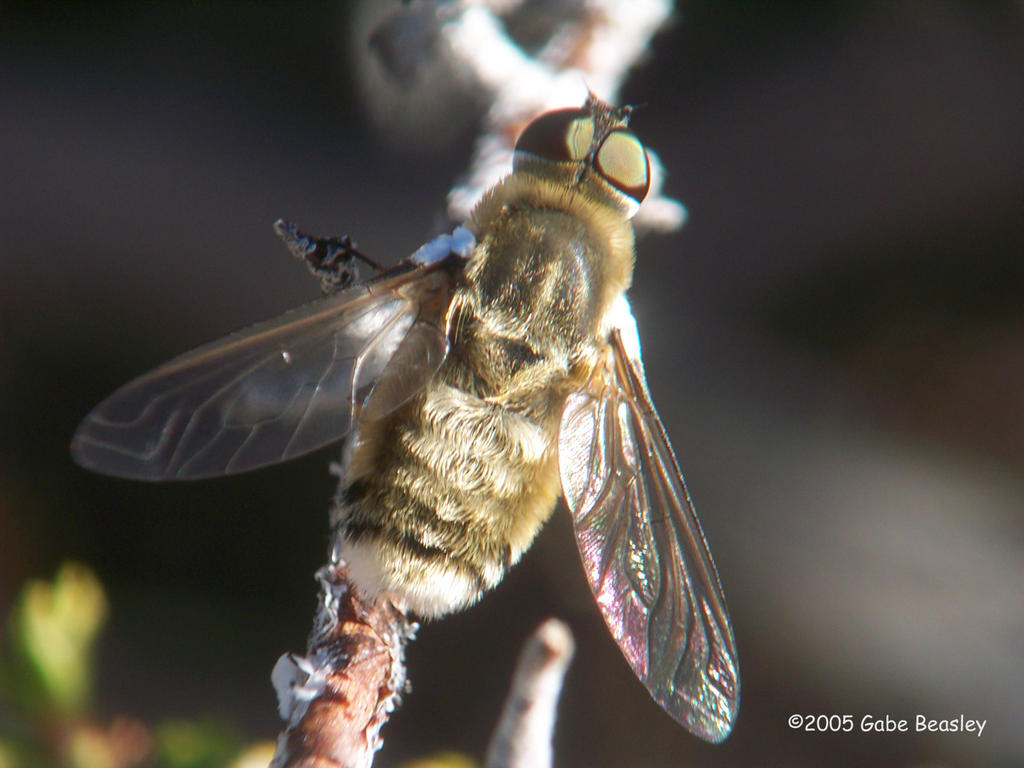
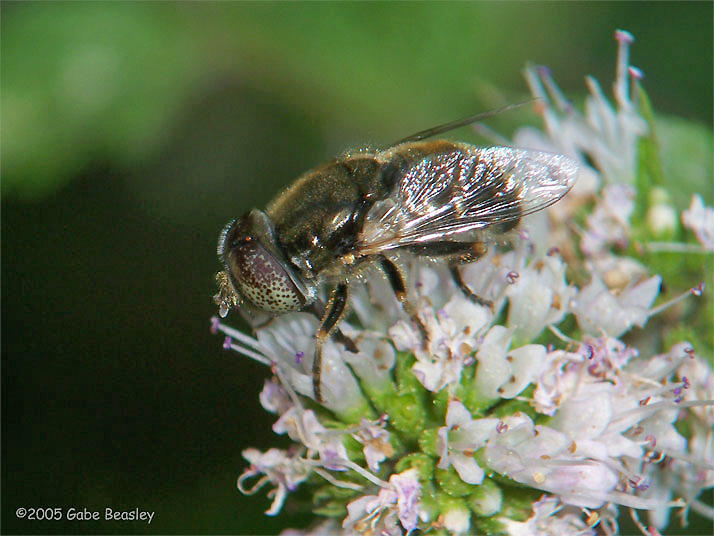
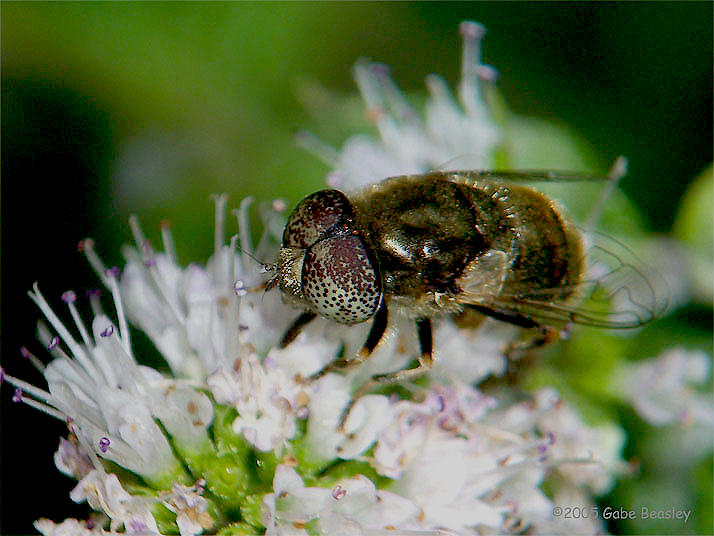
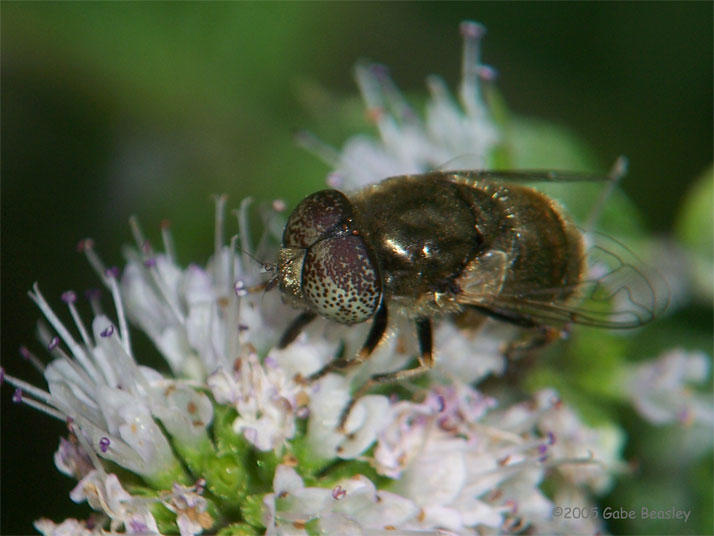
(Above-The Progressive bee fly) (Below- I have not identified yet)

(ABOVE- an unknown species of fly) (Below-The Progressive bee fly)

All these flies were hard to photograph but this one was not only the
hardest but the strangest. It does not seem to be any kind of Bee fly.
I have yet been unable to identify it. The huge eyes colored like
this I’ve never seen. I photographed this one outside my dad’s
house near San Jose, California. I did not have enough time to
take pictures when I was there– I will be back, both to visit these
flies but continue to understand the strange spiders I photographed
the first time. All are new to me except then Barn spider and the
Zygiella Atrica–I’ve dubbed those “Winter Weavers” because I’ve
found them alive and well during Christmas time in Portland
surviving freezes and moderate winters when I visited from
Hawaii each year. One of many spiders I used to smuggle into
Hawaii when I was a kid.


(ABOVE- an unknown species of fly) (Below-The Progressive bee fly)

Why are they called “Progressive” Bee flies? That I don’t know.
And these flies called Exoprosopa, are very difficult to photograph.
Recently I perfected a method of using some of my old 35mm
lenses with my digital that actually works. This gives me about
three feet distance to take shots like this. But when I took this
a couple of weeks ago I had not yet tried that. I used my long-
macro lens and this difficult to photograph fly was finally brought
into focus. I had to be five or six inches away in order to get it
or they would fly off. These flies look like flying bears. I’m
surprised they are not called “woolly flies” or something. This
family has a wide range of different looking flies however and
“Progressive bee fly” might have just been a name given to the
them for any number of reasons. It could be one of those moments
I’m just missing something really big about these flies that very
obvious. I photographed these near the salt flats on the California
Nevada border.

When my dad and I go camping and hiking--we go where nobody
goes. Miles and miles from any stores, rangers, or
other campers. We can't stand RV's, pay camp sites--and if the
place has signs its pretty much overused. We go camping to get
away from all that crap! At the best sites are remote enough you
don't see city lights on the horizon at night even over the curve
of the Earth. In such a place I took these shots just a few dozen
feet from our self-made fire pit. My GPS put us at allmost 8000ft
looking over the salt flats into Nevada.

The Progressive bee fly- found on Navada border