Monday, September 12, 2005

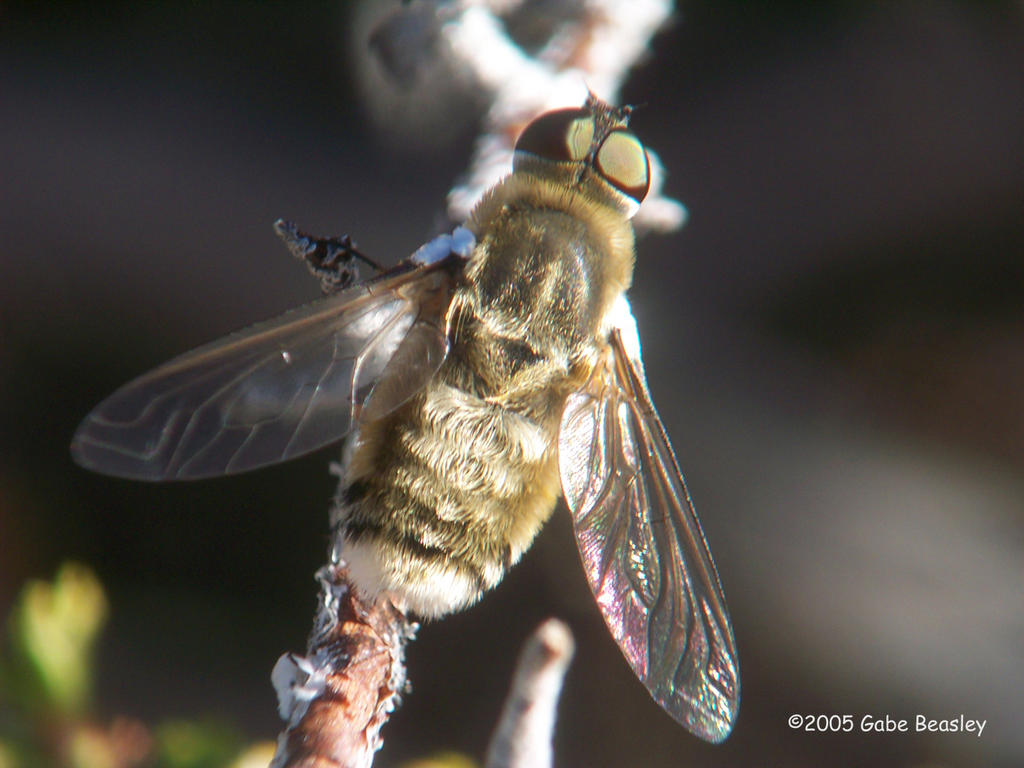
FLIES -and the "Progressive Bee fly"

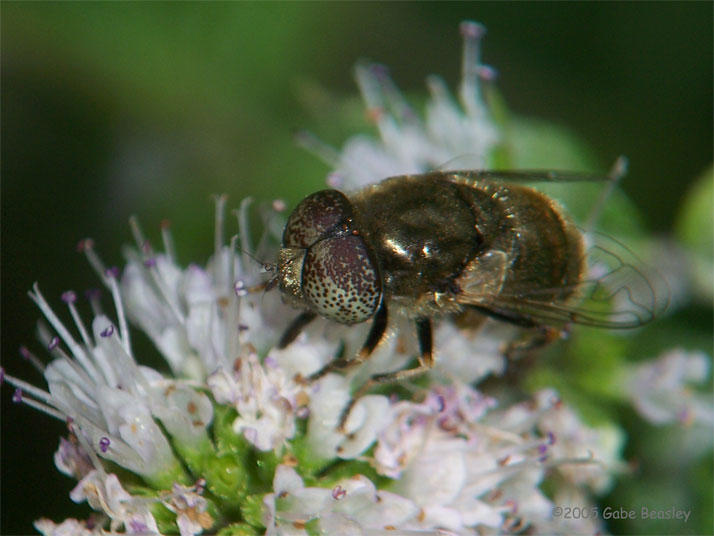
(Above-The Progressive bee fly) (Below- I have not identified yet)
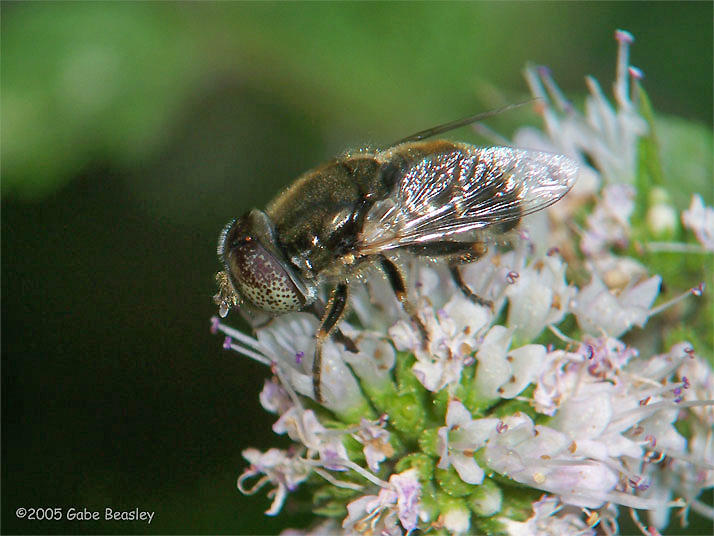
(ABOVE- an unknown species of fly) (Below-The Progressive bee fly)

All these flies were hard to photograph but this one was not only the
hardest but the strangest. It does not seem to be any kind of Bee fly.
I have yet been unable to identify it. The huge eyes colored like
this I’ve never seen. I photographed this one outside my dad’s
house near San Jose, California. I did not have enough time to
take pictures when I was there– I will be back, both to visit these
flies but continue to understand the strange spiders I photographed
the first time. All are new to me except then Barn spider and the
Zygiella Atrica–I’ve dubbed those “Winter Weavers” because I’ve
found them alive and well during Christmas time in Portland
surviving freezes and moderate winters when I visited from
Hawaii each year. One of many spiders I used to smuggle into
Hawaii when I was a kid.
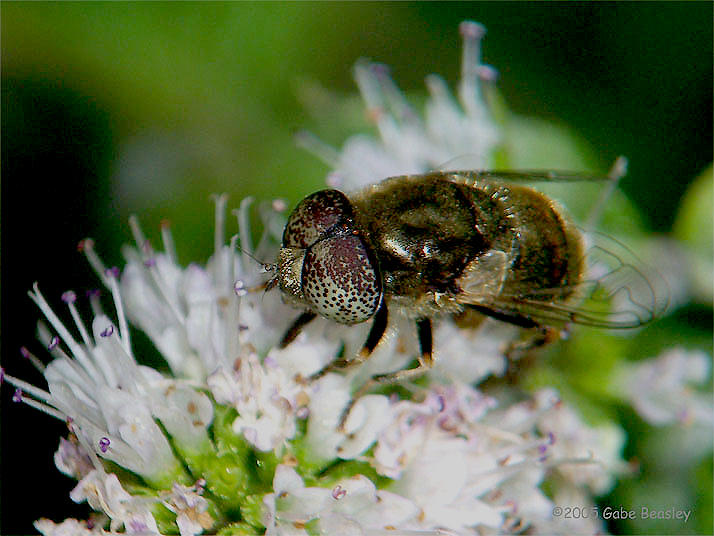


(ABOVE- an unknown species of fly) (Below-The Progressive bee fly)

Why are they called “Progressive” Bee flies? That I don’t know.
And these flies called Exoprosopa, are very difficult to photograph.
Recently I perfected a method of using some of my old 35mm
lenses with my digital that actually works. This gives me about
three feet distance to take shots like this. But when I took this
a couple of weeks ago I had not yet tried that. I used my long-
macro lens and this difficult to photograph fly was finally brought
into focus. I had to be five or six inches away in order to get it
or they would fly off. These flies look like flying bears. I’m
surprised they are not called “woolly flies” or something. This
family has a wide range of different looking flies however and
“Progressive bee fly” might have just been a name given to the
them for any number of reasons. It could be one of those moments
I’m just missing something really big about these flies that very
obvious. I photographed these near the salt flats on the California
Nevada border.

When my dad and I go camping and hiking--we go where nobody
goes. Miles and miles from any stores, rangers, or
other campers. We can't stand RV's, pay camp sites--and if the
place has signs its pretty much overused. We go camping to get
away from all that crap! At the best sites are remote enough you
don't see city lights on the horizon at night even over the curve
of the Earth. In such a place I took these shots just a few dozen
feet from our self-made fire pit. My GPS put us at allmost 8000ft
looking over the salt flats into Nevada.

The Progressive bee fly- found on Navada border


Sunday, September 11, 2005

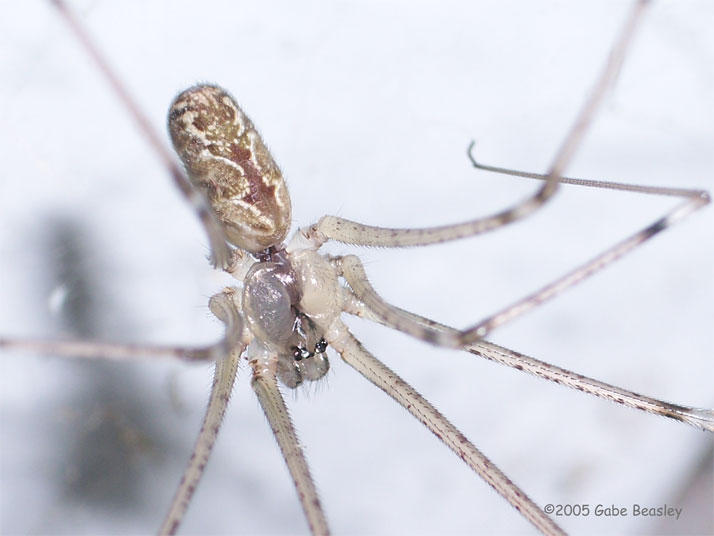
THE SUN-LOVING DADDY-LONGLEGS ?

When I got to San Jose California I had no idea I’d find this! I have found a lot
of fascinating spiders you might call “Daddy long legs”, from the huge cave
spiders in Hawaii (probably Hypochilidae) to the huge harvestmen we have
on the Oregon Coast here. But this one is truly bizare. And it's not very big.
It’s regular sized. If it were not for my knowledge of spiders I would have
quickly wrote it off as your common Daddy Long legs spider.
(Pholcus phalangioides).


(CLICK ON PICTURE FOR LARGER VIEW!)
Even with what I know that is what I first thought, their body size is exactly
the same, leg length–everything. Except when you realize most of them live
in bright sunlight making more sheet like webs on shrubs! Very odd
behavior for the Pholcidae–who prefer dark places and would not build
there webs in brightly lit shrubs. The next clue what the silk and web.
The web is built much like the Money spider, an upside down sheet sort of
shape but not very organized. These are daylight loving spiders–not often
concealed in dark places. Almost all of them I found blend in well enough to shrubs
to be confident but they must not have very many predators as they are easy
to see. They seemed to love sunlight–and that is where they are found–lots
of them. The most common obvious spider in that area. There must have been
5 to 15 adults per small pine shrub. Densely packed with webs nearly
connected like the Pholcidae living in packed basements.


In every distant appearance this spider looks exactly like it’s cellar, basement
and bathroom loving counterparts. But a close look revealed these are
no regular Pholcidae. In fact, I can’t really figure out what they are. Such a common
spider just outside of San Francisco is not going to go un-noticed. So
I’m sure an experienced entomologist (unlike my armature self) could identify this
quickly. I have yet to try looking on line to find it. It’s really amazing, I like
these kind of surprises.

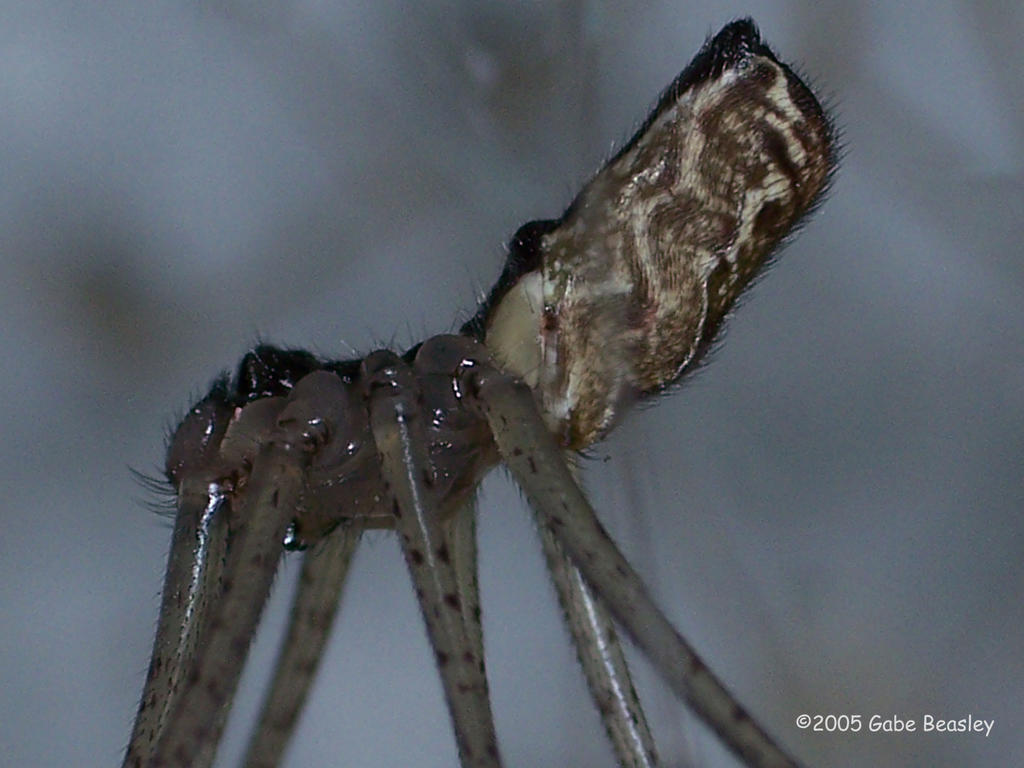
The similarities to your typical cellar spider ends at a closer look. They
live very much like Money spiders (Linyphiidae). They have colors,
complex colors, and then a close micro-shot of it’s abdomen and
cephalothorax shows just how bizarre and different these spiders are.
These got to be related to Pholcidae. But I can’t get over how much they
look like them at a distance. Body sizes and proportions are perfect,
leg sizes–everything. This however, in the scientific world of spiders
can mean little or nothing but a coincidence in many cases. Some
species are so similar the only difference that can truly tell are the
eye positions and very small attributes-serious detail.

(CLICK ON THIS PICTURE FOR LARGE VIEW!)
As you can see the cephalothorax is very bizarre, and mouthparts of this
male show huge palps swelled up–but not “jacked up” the way Hypochilidae
males. It’s also a bit small for Hypochilidae but I can’t be sure until I
get a closer look on my next trip.

I do not harm spiders to photograph them and did not have enough
time on this very short trip to do more then setup these shots carefully with
my specialized lenses. These closeups were actually taken of spiders in
there webs un-disturbed! I take a lot of pride in the lenses I built that make
these kinds of shots possible. They did not display the typical shaking
associated with the daddy long legs you might find in your bathroom.

And clearly these spiders liked the sun–many of them in the full
blast of the sun and being very daytime active even on hot days.
I have no idea what this spider is. Despite the serious differences
my best guess it that it is a species of Pholcidae that is just not
in the field guides for whatever reason. Remember, to make a
field guide takes A LOT of work, most of them in print are over
25 years old and still in print. Species can often move to new
areas or even become introduced by accident in new areas in that
amount of time. An important thing unfortunately I did not take
the time to capture one and look very close to find a cribellum–I
got too caught up in the photography and stuff to think of that.
This could prove key in identifying it. The silk and web would
have shown more–but once again I was really busy on this trip
and I did not take my typical silk, spent skin shedding or eggsack
remains or samples-I did not even go find a female. This was a very quick
trip and I had very little time to do in-depth stuff. I’m headed back
however–next month. I often do that to help identify the spider later. I am
perplexed. If you think you can tell me what this San Jose spider
species is–E-MAIL ME! Or just leave a comment here.


You might ask- why did I not take a specimen?
In this day and age with digital technology being as powerful as it
is, I do not find it necessary to kill spiders or often even so much as
take them out of their web to find the distinctive features that
can identify them. I recently found a digital video camera with
4mega pixels which can take both stills and non-choppy clear video
which is only the size of a pack of cigarettes. A couple of problems
solved and you quickly have a nice macro lens on it. For $150 bucks.
The unit has about 80min high quality recording time with a
1GB internal card. Using digital video and the macro lens
comprehensives descriptions and views are very possible. A
Few stills with a trained eye and you have it–the spiders most
vital areas of identification photographed. Granted I had to
invent my own lenses for many of my cameras to become practical for
this purpose–but most higher end small digital cameras over
$300 have macro-lens kits you can buy. And of corse a digital SLR
can be outfited with anything.

A good digital camera with manual controls and at least 3.2MP
and a simple macro lens can provide a very comprehensive
description that misses almost nothing if done right. With the
right lenses and a little time a spider can be totally described
at least outwardly–without a gruesome faded specimen or a single
spider being killed. Each spider only has a lifespan in most cases
of about a year. That’s a short life. I believe that all living beings are
sentient and still battle my very scientific mind about this issue
even today. Now I disagree with taking specimens especially
for surveys and other work that could be done with cameras.
IT is more expensive and complex–but what price can you put
on life in the name of science? Why kill what you study just
to learn of it if there are alternatives. I’m sure I’d get a lot of
arguments, but someday we will have to lose the idea that
human beings are the only animals that feel pain, fear and all
those other emotions as well as self-awareness of them. Even
insects and spiders, are not mindless robots.

In the un-likely event that I’m in a situation where I really think
I’ve found a spider not known to science, I would take a specimen
as that is important complete proof. I don’t believe every
spider-enthusiast has to have a creepy collection of dead faded
spiders in order to study them.

I like spiders–I do want to kill them. As I said–the days of needing
to kill masses of spiders for surveys and or personal collections are
in my opinion over. It is a little known fact that many spider species
have become extinct at least locally or gotten very rare are close too
it areas all over the USA alone due to development and whatever
people do–such as bug spray. Some species are even protected by law,
especially in Europe. I just don’t think it is necessary anymore and
I’d prefer not to kill them. It’s also an expensive and somewhat
difficult way of doing things. Any student of entomology probably
has a story of broken or opened gruesome specimen bottles full of
faded yellow chemicals and dead spiders ruining note books and
field guides at the bottom of there favorite bag! (At least I have a few)
Digital photography is so advanced an certain–usually taking
away the short life these creatures have just is not fair or
needed anymore- usually. A final note: I realize I am an armature
here, and this is purely my opinion based upon what I know.
I do not want to seem like an activist who is not willing to listen
to other views.

THE BARN SPIDER thats not ?

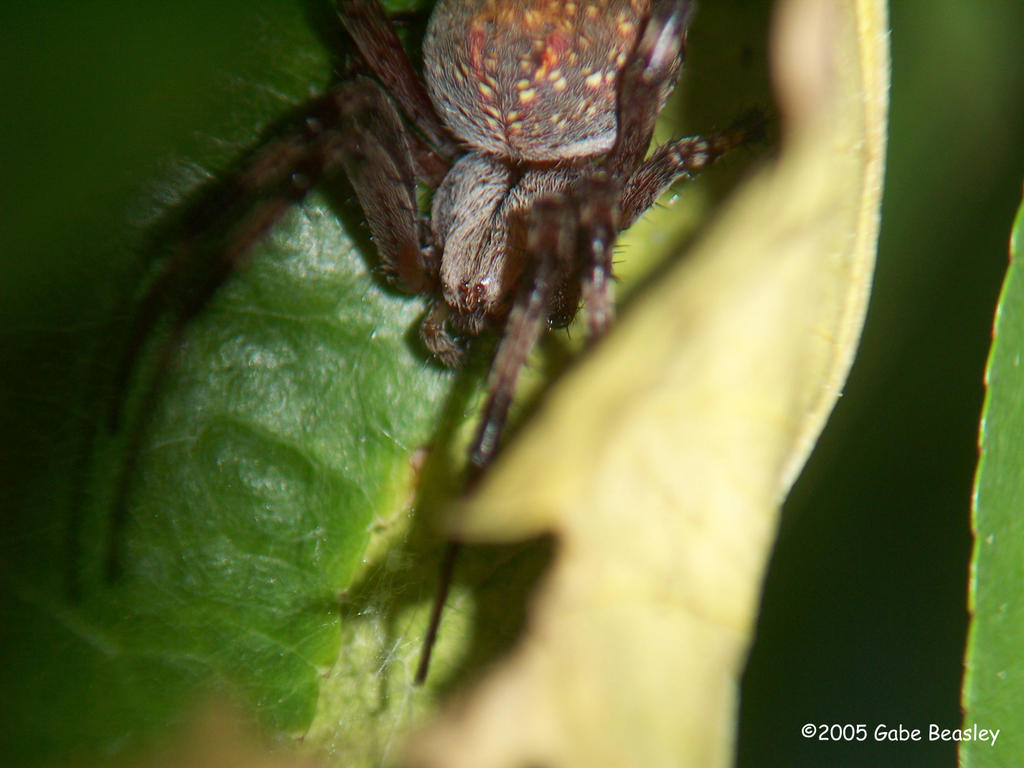
Notice the web, a bit of a mess so it's hard to see but the hub is much larger then the spider. Often you can get a general idea of how large a spider is when it's hiding by the size of it's hub--in this case, that was not true. She was far smaller then I expected. I have A LOT of pictures of her--I plan to add them more later tonight.


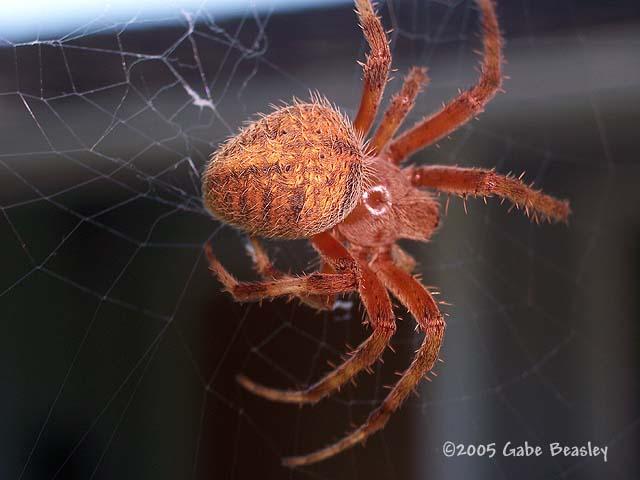
Now here is a true mystery. Had it not been for my identification of the
Barn Spider previously found on my trip to San Jose, and my growing up
in Hawaii--I'd have thought immediately that this was a small variation on
the Barn Spider. (Araneus cavaticus). In Hawaii, there are countless variations
on a spider the same size as this one, as is this one, smaller then the Barn
Spider (go down to see the Barn Spider in my website), and with different
proportions in key areas. In Hawaii I found countless mixes of a similar
spider that varied in colors but had the same body theme and it amounted
to races of what was probably all the same species or very close. I am not
sure--none of my books accurately identify this spider completely. I was not
able to look enough to know if there are variations but it almost definitely not
a Barn Spider as I found just on the other side of this same house. She is
probably fully grown, and I have no idea what the true name for this spider is.
Due to coloration it's probably often identified as a the A. cavaticus, very possibly
wrongly. I cannot be sure about this--but the number of spider similar to
this very tropical species in Hawaii is incredible. Dozens and dozens of mixes.
I can't identify this species exactly. Nor can I connect it to the ones in Hawaii
except by saying there are many similarities and this spider is definitely
more tropical then the Barn Spider--which can be found here in The Dalles
Or where we can have six feet of snow and cold winters every year. It can't
be found in Portland either as far as I know. E-mail me if you can identify this
one--I really want to know what she is. I have lots more pictures of this one.
She measures about 1.3-1.4cm or so.

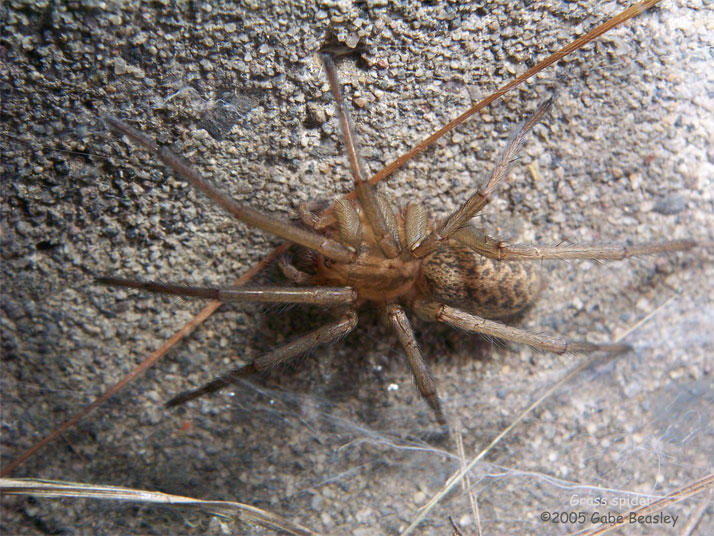
The Grass Spider -one of many-NOT BROWN RECLUSE

This is a very common species. Possibly the most common of all spiders in many Northwest places. This is NOT A brown recluse! I was very mad at one site that used a picture of this very common garden spider to sell there products. This spider is VERY common and There are probably well over 100 adults living in any small yard and house with room for a small garden in the backyard. They are shy and not at all related to dangerous species. These spiders can be seen by the dozens making there sheet webs on shrubs--and also can be found in rocks or under them, where I found this female. All spiders are potentially dangerous, do not handle--but please do not kill. These spiders eat 1000s of destructive insects and that can be very well seen if you go into your back yard, garage or basement where these spiders can sometimes be found and examine the remains of there victims. They are major insect predators. Agelenopsis sp. (Agelenidae) There seems to be several varieties of this spider large and small. Another common name for it is the Sheet Web spider as they make sheet webs with a funnel that they hide in. They are very shy--and will run at the slightest bump. I have a lot of pictures of this spider I have yet to post, this one I took recently of an adult female.

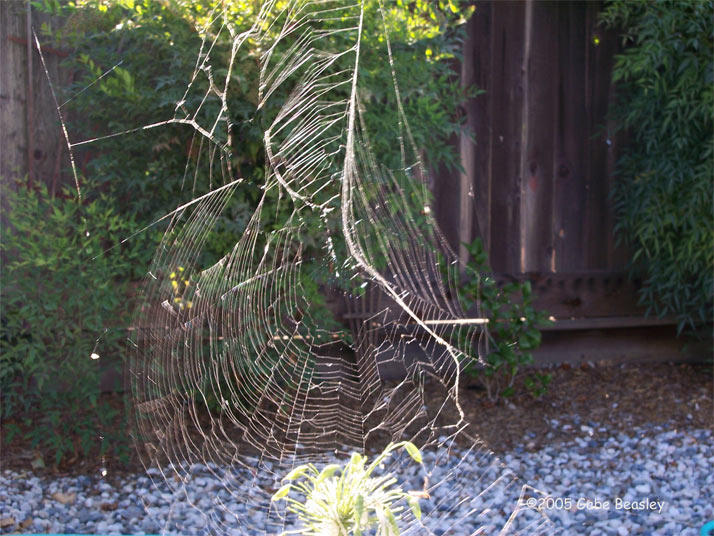
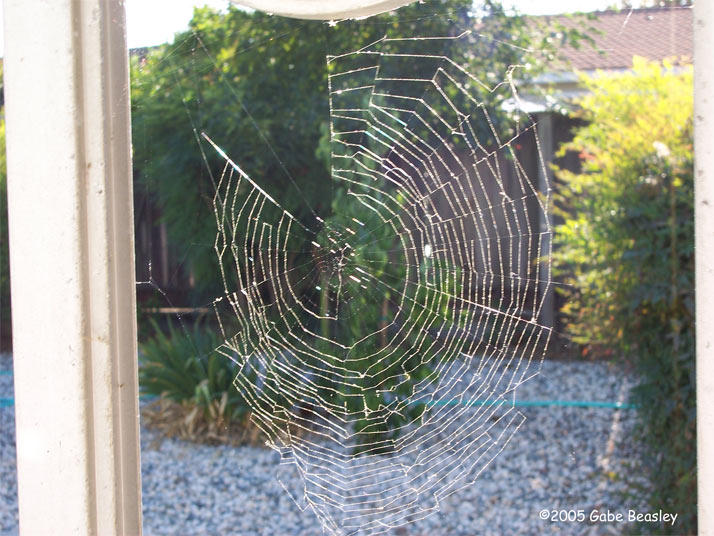
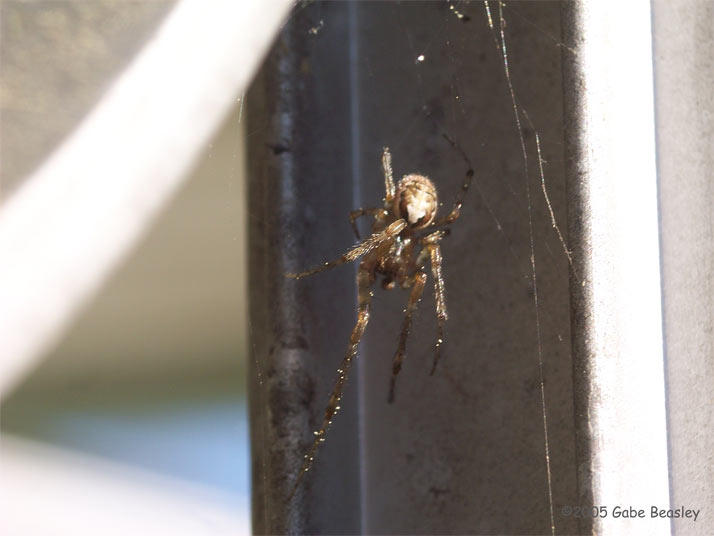
What I call the "winter weaver"

This is the web of the humble small "garden spider" that is very common from Seattle to
San Jose where I found this one. I've observed them building webs and living through
winters in Portland even at Christmas time when it freezes so I dubbed it the "winter weaver".
That's just what I call it. It's true name is Zygiella atrica. She's only about 7-8mm long body
size when fully grown. Above is the web of the spider below carefully well made on my
dad's patio.


Thursday, September 08, 2005

DUST DEVILS on the way back from CA

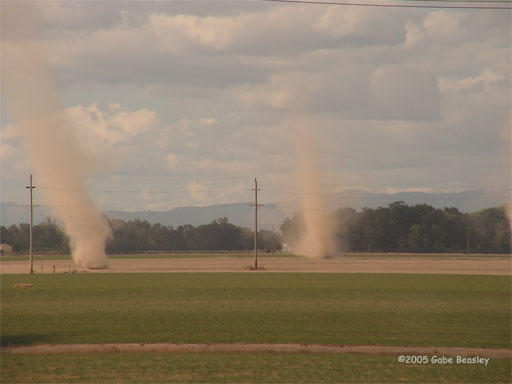
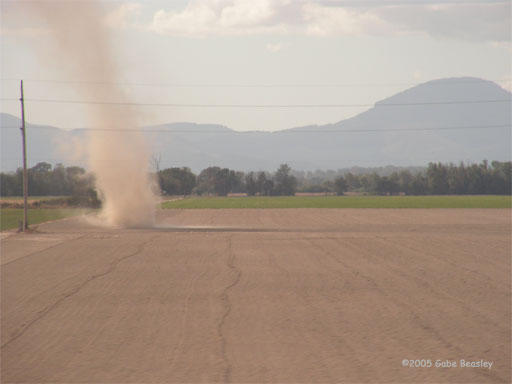
It looks like a tornado if you have never seen one but this is only a dust devil. Dust devils can get large enough to do serious damage, but very rarely. Most of the time they just produce and impressive display of dust in funnels that can go to the clouds--and watch out- fences near these things are electrified with enough static electricity to throw you several feet in the air! I captured these farmer's pests while I was on the train coming back from my trip to CA. It is every photographer's nightmare to try to shoot from something moving at 70 miles an hour--but I did my best with all manual settings and a short enough shutter lag.

Here are two of them, there were as many as three. They whip dust around at high
speeds and when they get this big I would not recommend getting close to them. Although
they are not tornadoes--they can do everything from generate high voltages to seriously
burn your skin and eyes with all the dust. Winds in these things as you can see can be
very fast and in rare cases large objects can be picked up and even homes seriously
damage by the bigger ones. They touch down anywhere the air temperatures are
right--and could happen anywhere in the USA. Mostly flat cropland makes for the
right conditions. But once I got caught up in one when I was a kid up picking blueberries
in a very odd place near a local mountain. When I got into it dust went into my eyes
and every part of my cloths--it was loud-and a bit scary. Since then I've been through
a class 4 hurricane and several tropical storms, but this first experience with fast winds
and stuff left an imprint even when I was very young. Wondering what the heck all
those leaves and dust were doing. Notice the telephone poles--some of these suckers
really get big.


This is as close my train came to one. Of corse the nearly bullet-proof glass on the
train made it invincible to even the worst of these things and the junk they can
pickup. But recently I heard a story about one that touched down just outside of
Portland and tore off part of a roof as well as did other serious damage that
could have been deadly. They are not tornados however and the quickest way
to tell is not only the size but the fact that they do not connect to the clouds. Showing
there size is truly not like that of a tornado. I'm not pretending to be a meteorologist
but I believe there are some differences in them which classify exactly why they don't
become tornados and stuff. Maybe they do when there are thunder clouds? I doubt
it. It's complex weather stuff I don't know jack about. Just that they both have something
to do with rising temperatures and the pressure difference between hot and cool air.
Heat rising quickly and stuff.

Tuesday, September 06, 2005

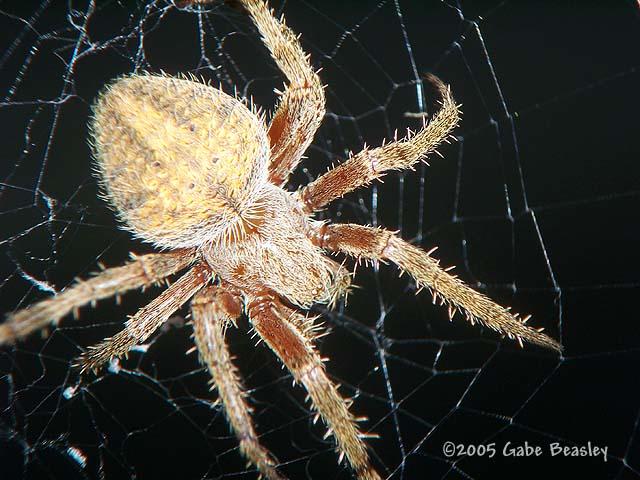
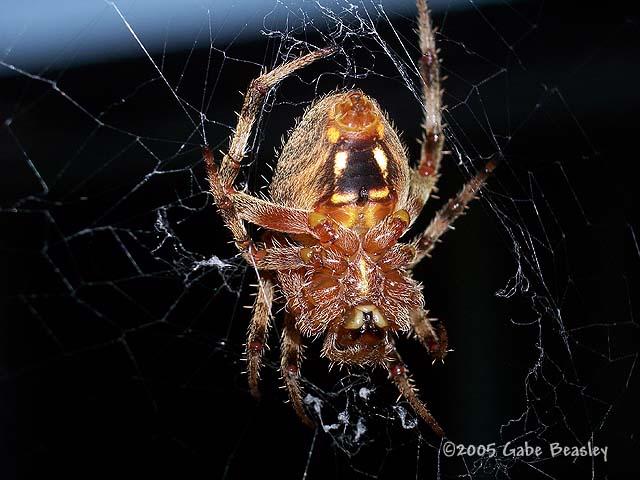
Araneus cavaticus (The Barn spider)


These were some of the most difficult pictures I have ever taken. It took me over 50
tries to get it right. Her web was blowing in the wind and despite appearances it was
bright and sunny on each side as well as above the web. My cameras auto-sensors
had to be tricked into firing the flash at the right time. In this rare time when my
cameras all manual controls failed because of the flash and the wind. The spider
flew in and out of focus at speeds requiring me to shoot with at least a 250 shutter
speed and so to get depth of field I had to use a flash. My shots of it without one
are blurred and lack the depth of field I crave in my pictures. It took me over an hour
of standing in the same place to capture these pictures.

An important note here. It is pretty well proven spiders lack ears--but they are able
to detect sound. I had to talk to my dad as I was taking these shots just before I left
to the train station. They were taken outside dad's house by the garage. The spider
reacted to every sound. Even my whisper near the web made it jumpy. In fact–the dog
inside my dad’s house–(not very loud) made the spider jump every time. I should have
documented this on digital video. This spider is clearly sensitive enough to sound
that it can detect people talking from up to 30 feet away. The dog barking inside
being as far away and slight a sound that was–seemed to scare it the most. There was
no question–it only jumped and did jump in a fearful way–when I talked near it
as I photographed it–and when the dog barked. This is one sensitive spider. Either
it’s hairs or it’s web or both provide a form of detecting sound. This was one tough
picture to take.

As usual I set everything on manual and then trick the auto-flash sensors with a small
light to get it to fire at the right brightness. The flash does have a manual control--
but it's second sensors in almost all conditions produce a supplementary setting
appropriate for the scene. Using high powered macro lenses and with very bright
light both above and below the spider confused my camera. It was very difficult--but
I got it done. These Barn spider pictures are some of the best I've done for larger
spiders. We don't have very many spiders this large in the Dalles--but we do have
Barn spiders here as well. I just have not found one yet. Barn spiders can get over
15mm in body length and thus are large and not what I'm used too. The difficult
lighting aside--I really like these pictures. There are many more and they have a
pro-poster-perfect detail of 6.1mp. The full sized versions are for sale as are all my
pictures--e-mail me for further.


She turned through her web back and forth as they do to both view and bewilder potential predators when afraid. This is a ventral view.