Saturday, August 19, 2006

A NEW LOOK the Praying Mantis 2

arjhdd
"Hi, I pray before AND after each meal"--this guy looks too much like an alien.

I have did extensive close-up views of the praying mantis last year. You can find them under "all pictures" if you look around a bit. I still have a number of pictures I never published here from then. After finding two of them on my deck I decided to get back to take some new shots of them with some bit of new ideas. I had thought of allot of new angles and possible shots. So I got started when I put this female in a large special jar. A warning here--taking a praying mantis into your house could get it killed very quickly. If it gets trapped somewhere you can't get too it--or flies into a fan--there are many things. NEVER put them or any other insect in USED COFFIE CANS THEY STILL CONTAIN TOXINS FOR BUGS AND WILL KILL many insects or spiders you put in them. I learned that lesson 20 years ago, so it may not be true anymore--but I just be safe and buy clear glass or plastic food jugs.
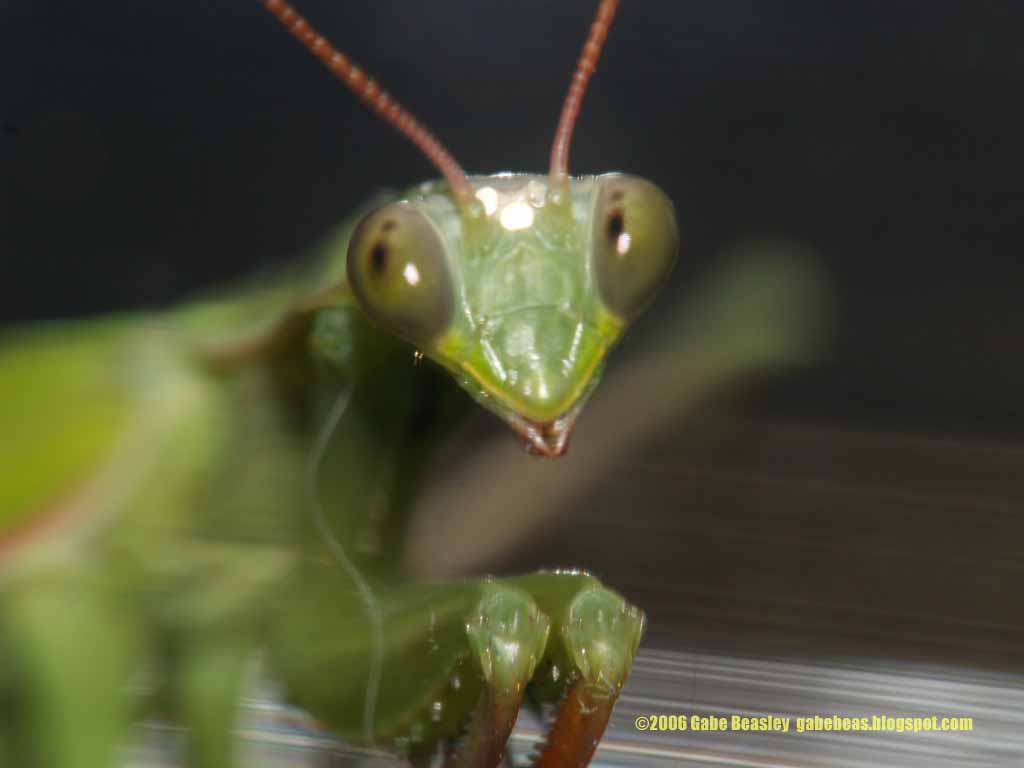


"Mantis baby picture"

The background here was NOT done in Photoshop (or any other photo-program). I like that. In my humble opinion, I think some people sometimes use a bit too much Photoshop or other photo-editors. You can shoot excellent pictures in-field if you try. Shooting RAW gives you a chance to somewhat do both. 95% of my pictures are un-touched and are straight from the camera. I am proud of getting a shot right from the camera. But don’t take that wrong, I have several photo-related graphic art projects I have done in Photoshop. I am also proud of them. Have some interest in the idea of changing, blending and morphing photos so doing making artistic creations (like that girl at the train station) in Photoshop with layers and filters and color lighting controls. I enjoy getting something right when I do this. As far as I recall I have noted every graphic I have done on this site. (That means like the above picture, I may use opical illusions, but this picture has not been edited with a computer and could have been taken completely with a 35mm slide film) The same is true for nearly all my natural history photos.


THE MAIN IDEA is if it is a complete true-life natural picture I want I try to get it in the moment so I don’t have to worry about doing much work on it later. I learn my cameras and usually do everything completely manually (even the flash and white balance) (and this does no require expensive in-camera editing). Most pictures are just stamped with my name and
downsized for the net so they can't be stolen very well and most of all they don't take a week to hour to load on your computer! Even if you have the quickest computer--it would take hours to load huge JPEGs and in TIFF weeks. If I try to post a large file by accident I know it right away because I come back to my computer a half hour later and blogger is still working on posting the file!
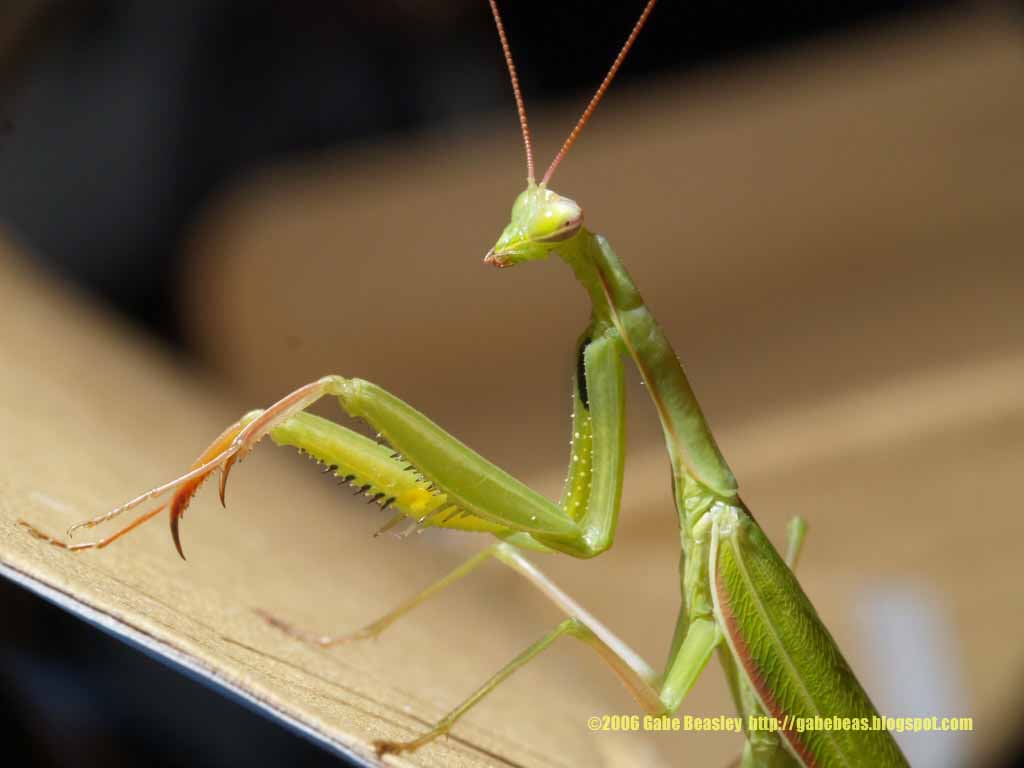


When I found this newly molted girl I figured she stood a serious chance of being killed by the backyard cat. So I took her carefully inside for some pictures. Some friends of mine actually showed me her first. Here you can see it's killer power and claws. These are of course NOT poisons, but will crush the life out of any insect they can catch. They will even take food if offered--BUT do not feed them human foods! As I will note later--be very careful when or if you ever do this or you might learn the hard way what can happen when a praying mantis or other insect gets loose in the house.
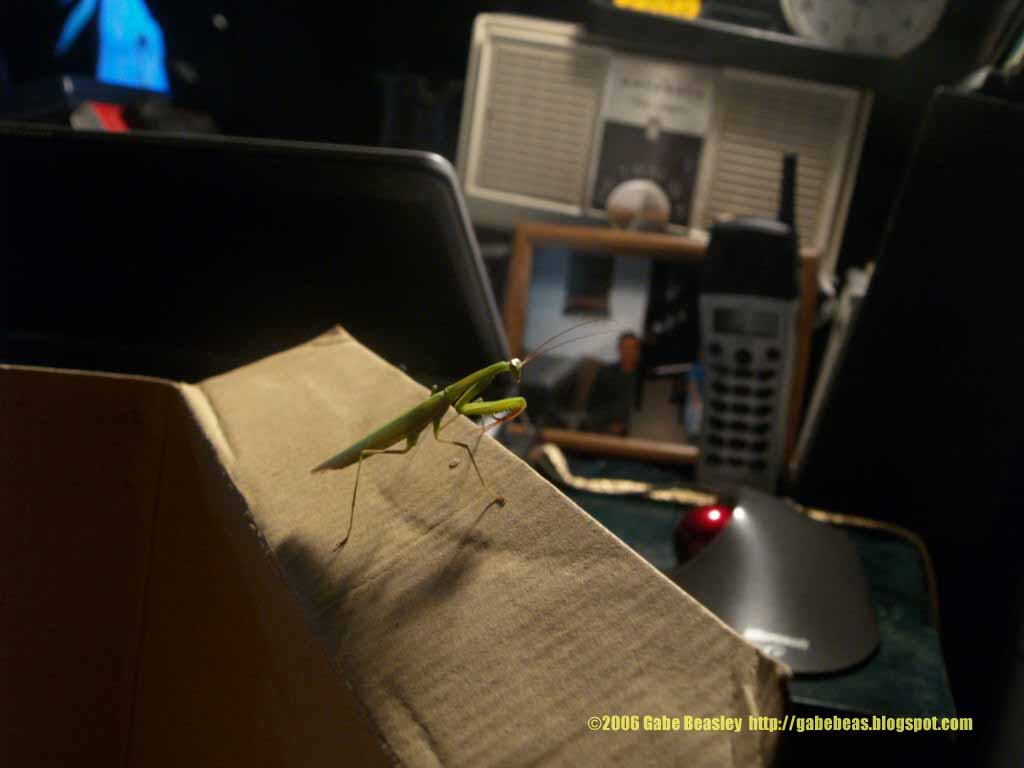


This was a real a medium high iso shot of it on a small box on my lap. You can probably tell from the phone in the background kind of how large she is.
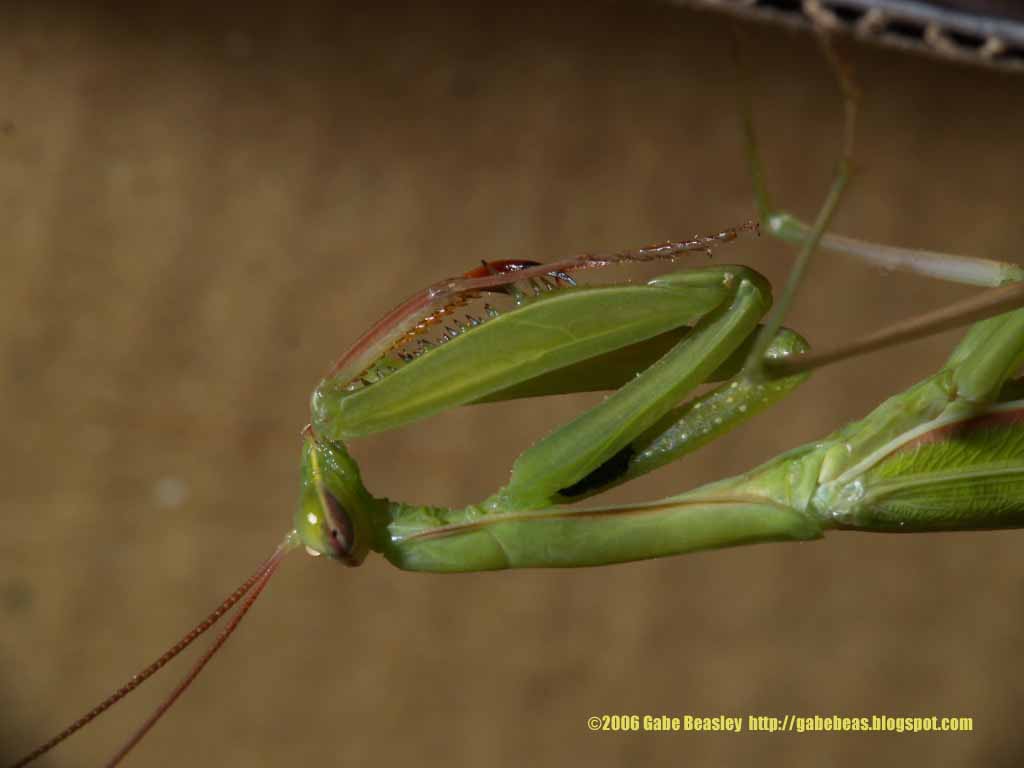


MY CHOICES IN LIGHTING
There are going to be some underexposed shots coming up here. As I said I usually shoot straight from the camera. I suppose I could go back and pull the CD with the right serial number for these pictures buried in my archives or hope it’s on one of my five hard disks. But instead I figured after trying one, they actually give content to the image. I think that these underexposed pictures are not so bad after all. I don’t know what this looks like, but to me it almost gives an impression of the secret world this creature. Having to hide in the shadows or in the brush waiting to pounce on it’s pray with a quick prayer. Of course they don’t really pray? But they look for it? If you want to buy a brighter one--e-mail me and we can make a deal for a CD. Some may look better brighter and some may not. Shot in RAW, I have allot of flexibility with these pictures.
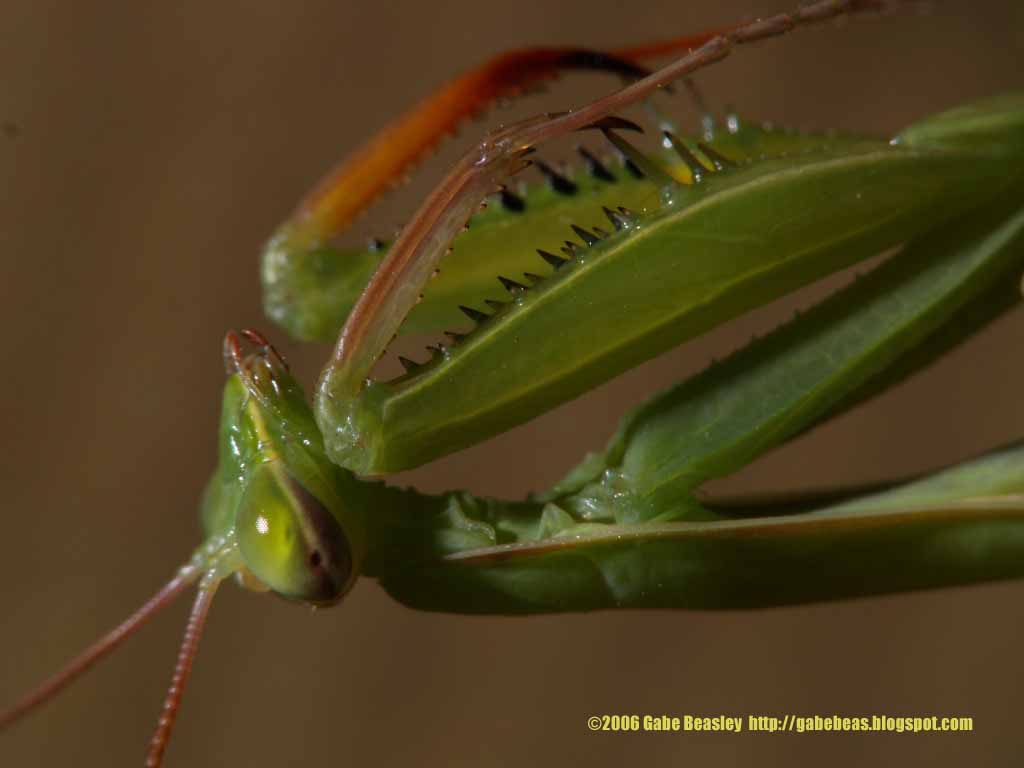
She has been touched by a human, and she feels contaminated. I have seen more "emotions" in praying mantises then any other insect. From rage to fear to getting used to people--they do things that are usually only possible in vertebrate animals. They have a super high powered condensed brain. She needs to clean herself after being captured by me.

BUGS ARE CLEAN?
Most people have not got a good look or even know at all how much insects clean themselves. Yes they do, to what would be an obsessive degree in humans. They clean themselves just like your cat or dog does. Now you can see this as I continue to try to get people to understand insects and spiders are important parts of nature, works of art, and many things to teach us--we must change our view of them as we are the only ones smart enough to do so. (BELOW)
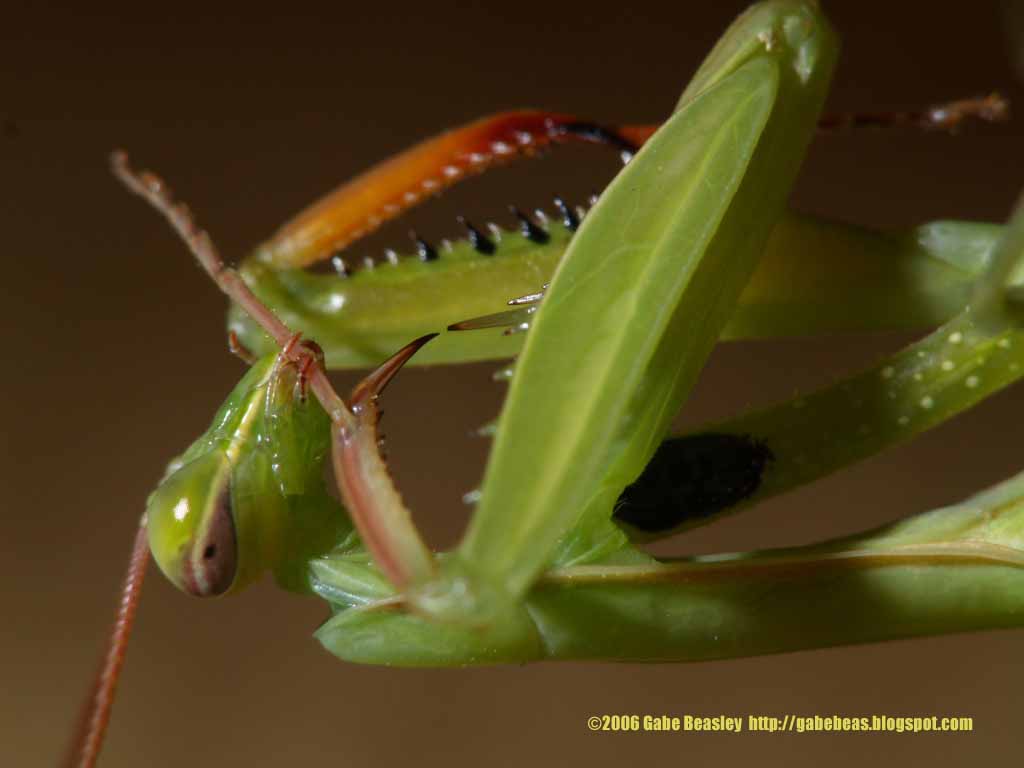
She continuues to clean herself--
Showing those spikes and knives that are so deceptive when looked at in another angle.
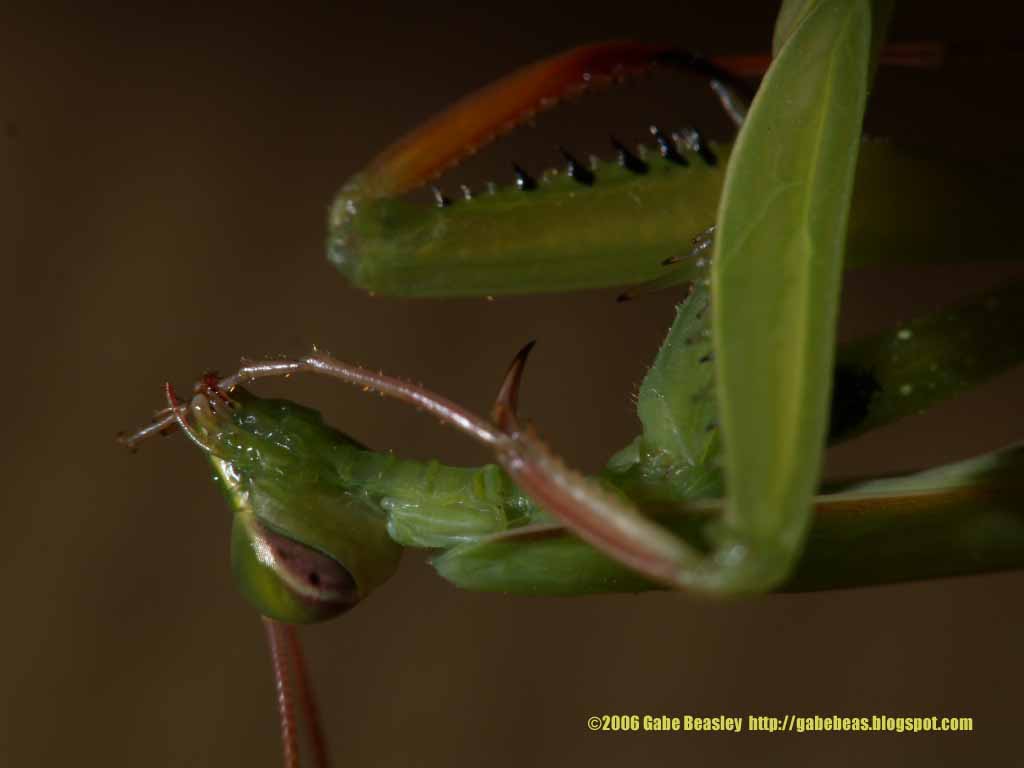
The tips of her formidable weapons cleaned for the kill

SPIDERS DO NOT SPREAD DISEASE -In fact I have never heard of a case of a spider carrying a disease. The main reason is for this is that spiders do not actively hunt or eat people. They only bite in self defense. Therefore they are not exposed to human and vertebrate infections. I might be wrong here---but to the best of my knowledge there is no spider bite that will actually cause a disease because of a "dirty spider". Spider incessantly clean themselves with a very powerful saliva which keeps them clean and from developing infections. And the acids and enzymes in there mouthparts do not pass diseases along because one spider hardly ever has the terror of biting one person and then the next with enough danger of a disease staying on its' fangs. When bugs clean themselves it is not different then watching your dog clean himself. None at all. The real “eeew thats gross!” is all in your head. Such crap belongs in B movies.
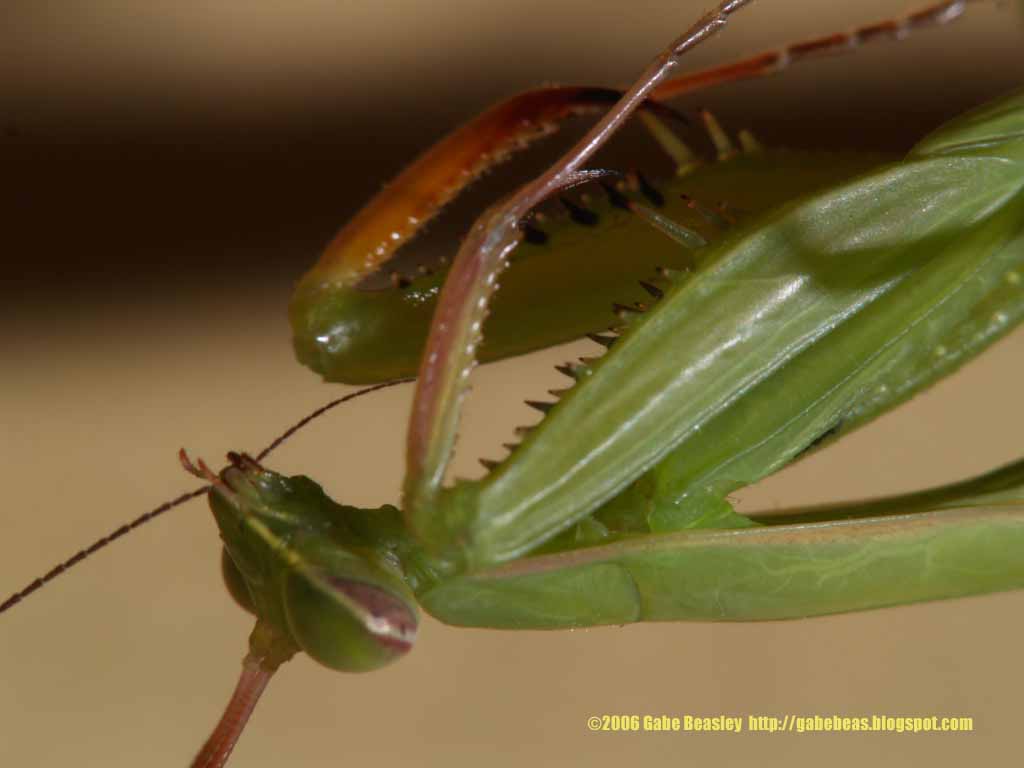

Each of her delicate antenna--

TO THE BEST OF MY KNOWLEDGE
THERE IS NO DISEASE CARRYING SPIDER and the mantis keeps itself quite clean as well as you can see. ‘BUGS’ ARE NOT DISEASE RIDDEN! -In fact I have never heard of a case of a spider carrying a disease that effects humans. And most insects have far less harmful infections and the other kind of “bugs” then we do on our skin. Exterminators would hate me to say this--but bugs are usually surprisingly clean. Extreme exceptions exist of course, like flies and some cockroaches. Your average bug is not a septic mess at all. The main reason is for this is that spiders and other insects do not actively hunt or feed on people. They only bite in self defense. Therefore they are not exposed from human to human as happens in vectors like mosquitoes or animal to human and thus vertebrate diseases. I might be wrong here in very rare cases---but to the best of my knowledge there is no spider bite that will actually cause a direct disease.

But the worst kinds will cause a kind of horrible flesh-eating reaction (Brown Recluse)- that is caused by enzymes built to break down their pray for some odd reason have a very serious reaction to human tissue. Being bitten by a "dirty spider", NO. If it’s not on the top list of dangerous spiders your probably fine. There is allot of Hobo spider hubbub on the web, but I take it with a huge grain of salt. Don’t handle any spiders with your bare hands--but don’t panic and kill them because you think it looks like a brown recluse or hobo-spider. I have had such a hard time finding a brown recluse I have yet to photograph one. I have only seen one alive on my own in my whole life. However ANY BITE OR STING from anything can become infected. Whenever I get a bite I let it bleed if it does for a couple of minute, then I clean it with rubbing alcohol several times (or wipes). Spider incessantly clean themselves with a very powerful saliva which keeps them clean and from developing infections. And the acids and enzymes in there mouthparts do not pass diseases along because one spider hardly ever has the terror of biting one person and then the next with enough danger of a disease staying on its' fangs. When bugs clean themselves it is not different then watching your dog clean himself. None at all. The real “eeew that gross” is all in your head. Such crap belongs in B movies.

Down to the very tip!

INSECT MYTHS and INSECT FACTS
Most people don’t' know this but even cockroaches have been known to clean themselves after touching humans. Unlike what exterminators want you to believe, bugs are normally incredibly clean. Using high powered natural disinfections to fight off everything from molds to injuries, they have to clean themselves several times a day. Often more. Many insects are compulsive at cleaning and when captured are found to be incredibly clean biologically. The idea that insects carry germs is often an urban MYTH. However, flies and flees, ticks and mosquitoes--to name a few deadly ones--have been responsible for horrible human tragedy. Flies do clean themselves, but they are still the dirty insects. Views of them at very high macro often shows molds and other things growing on there skin. If they were somehow capable of being larger--they would stink way worse then any pig or even an obsessive person!
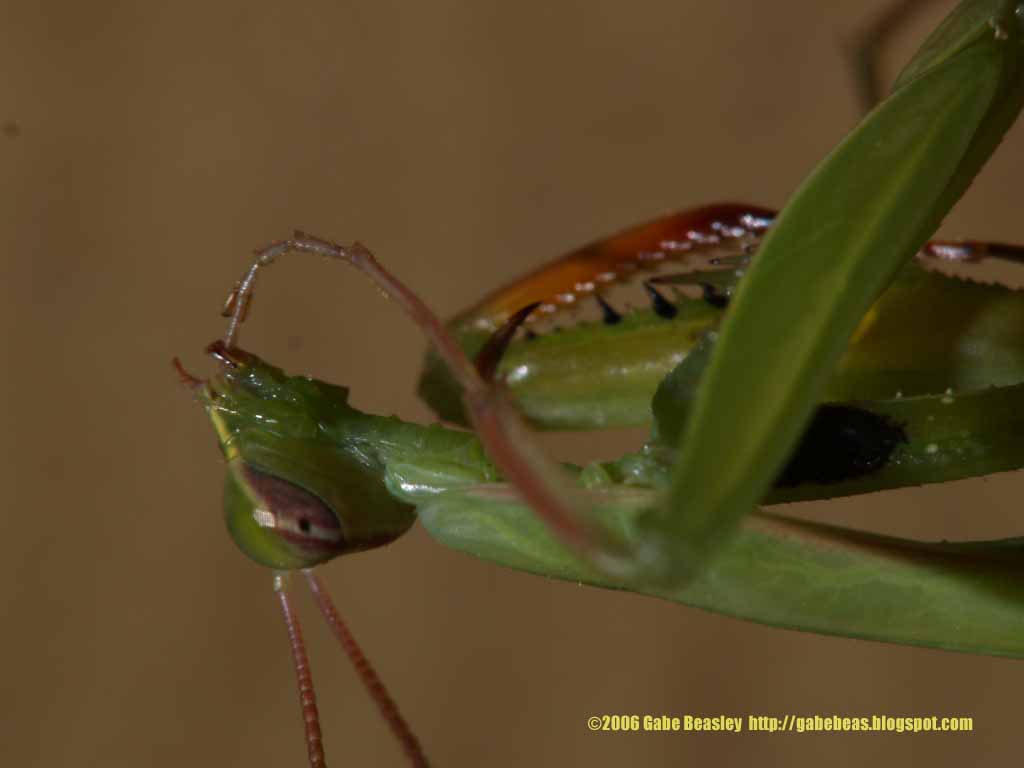


Again all important deadly arms--she will do this every time I handle her.

--Flies still have powerful chemical aids to keep from getting sick while inside rotten meat or some other terrible place. This is so they don’t' get sick. Mosquito’s and flees carry disease through there blood hopping--very much like a hypodermic needle being used by multiple people, an infected mosquito then spreads it to other people. Mosquitoes have been estimated to have killed more people then all the wars in all of history. Are war with them continues with the West Nile outbreak. Malaria continues to ravage poor nations. My take on it is to use repellents, nets, and be careful to learn how to ware more long sleeved cloths when you can if you can stand it.
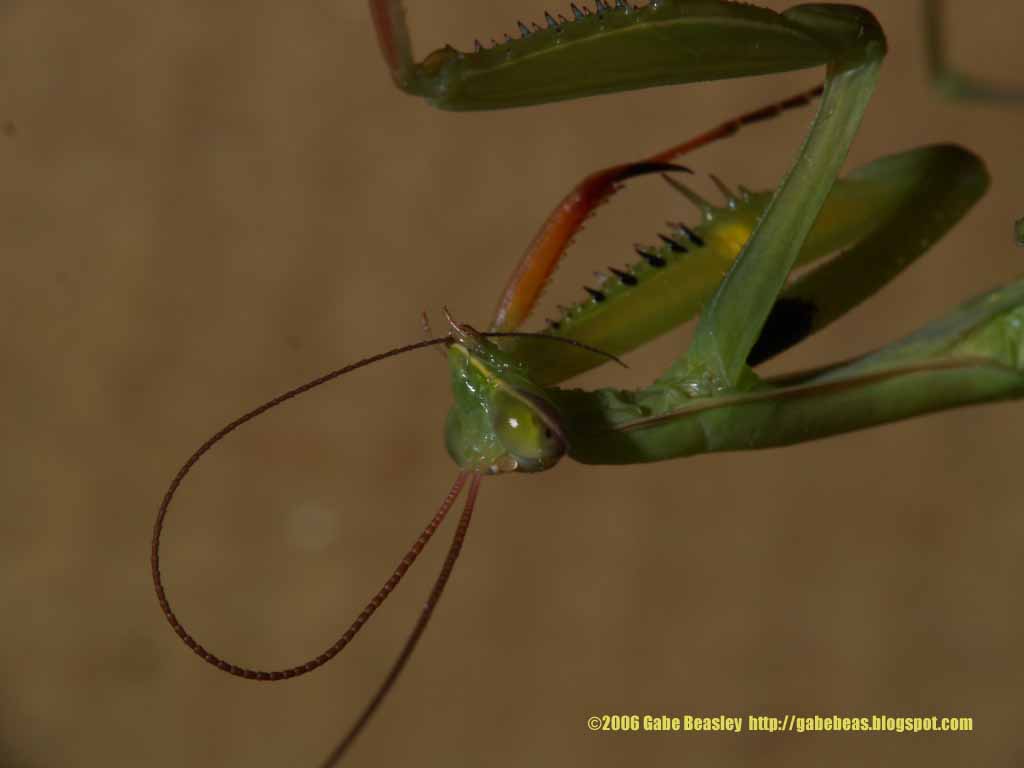


The other antania cleaned--


Take a look at this move! I managed to catch it, this is how she cleans her back legs. She won't stop, until everything is cleaned!

Down to the next back leg and those death clamp arms are used to lean the head as well as the her neck cleaned with a form of saliva similar to what dogs and cats do.
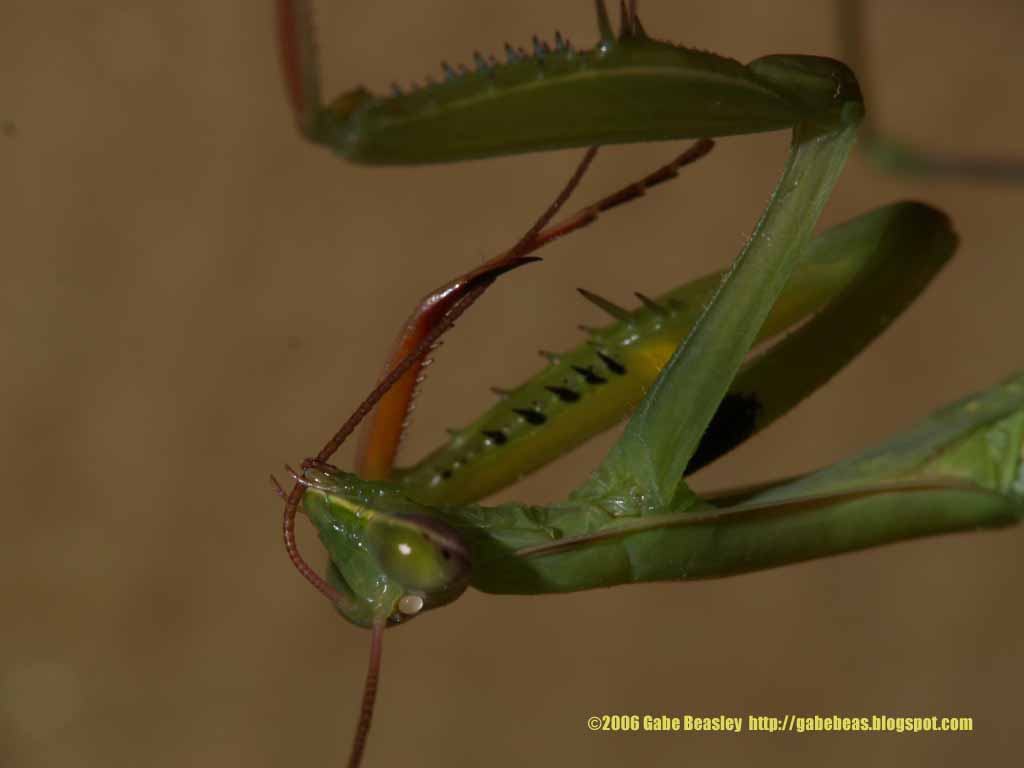
And finally she cleans and checks on everything with her feelers--
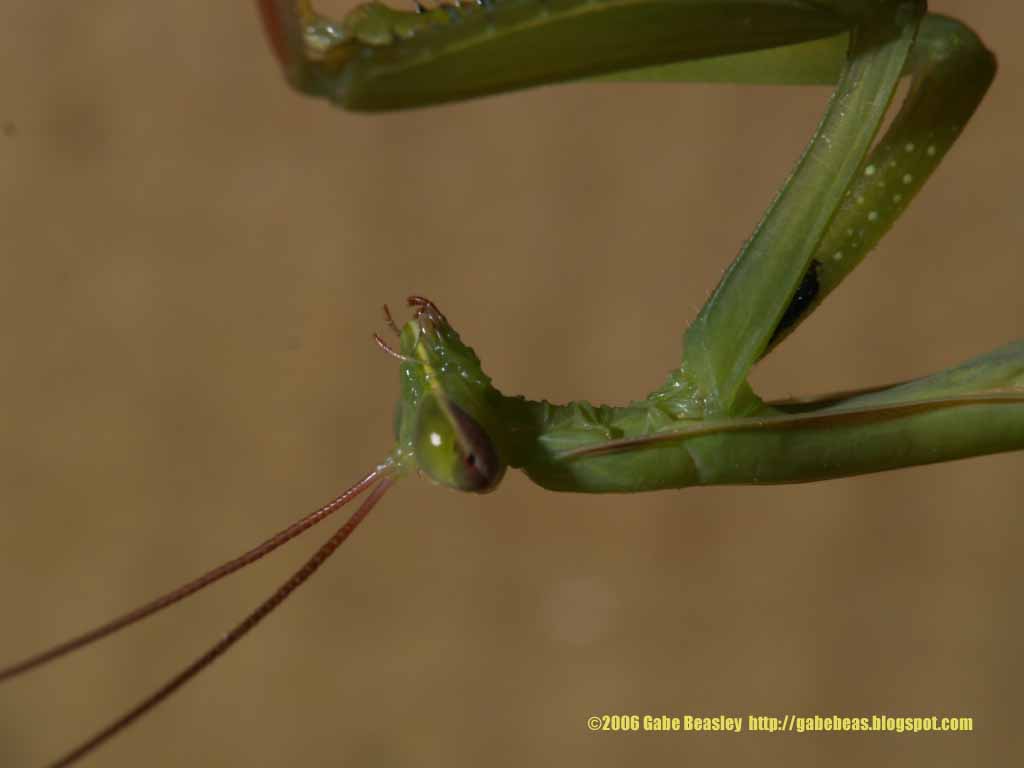

Now we got a clean Praying Mantis.


"Outside of the box"

Here she is on that box again. I must say again here that I have many years of experience handling insects. I brought her inside because I know the dangers and I know how to "read" insect. I can anticipate before they fly away and stop them---I know what signs to look for. There are many tricks you have to know in order to handle a praying mantis safely--both for you and the mantis. If you just grab one you run the risk of hurting it and you will get pinched and bit. I strongly recommend you let them on your way. This is no BS here, it has taken me many years to "read bugs" and know how they will respond. Watching them and photographing them since I was a kid and now far more actively. I usually know what she will probably do and even think several steps ahead. Very much like reading a dog or another animal. Training is not all that complex, and it would not take long for me to teach someone how to properly handle insects and spiders--it then becomes however a learning point. And the more experience with it, the better. The more bugs you catch the better you get at catching them. Knowing if the spider will drop out of it's web to escape or go up to it's hideout. I just picked most of this up over the years of being interested since I was a very young kid. My parents don't even know when I started getting into bugs, it's about as far back as I remember. Knowing how close to get to a praying mantis with your camera before it will fly away. Knowing how to use a net effectively to capture large amounts of specimens. Knowing how to put your subject in a pose that DOES NOT REQURE any kind of KILLING or even chilling. In these days of high-resolution digital cameras, I think the days of rickety discolored or broken up insect parts is over. We now have an inexpensive way to collect the insects we love without hurting them. That is really cool.

THE DIGITAL BUG COLLECTION
I am an amatur here when it comes to all this--but digital power holds new promase for -------------------------------------------conservation of species

It's time we put away those ugly colored jars and broken up bug collections and begin to do PASSIVE SURVAYS. Only capturing an insect to photograph it. How to setup a number of shots that will confirm it's species. Most can be fully described on surface in less then 8 good shots. In this instant and digital age--and with more and more of wildlife habitat being destroyed--we need to start to think of bug collections that are DIGITAL. My bug collection is now DIGITAL entirely. I made at least 3 GOOD insect collections in my life. All of them eaten by ants, broken in moving, or lost. The bottom line is no matter how much you try they fall apart and don't survey allot of value. I think that the idea of a digital bug collection
that requires no killing of the specimen and can be carried on a small chip that fits in your hand is the way to go into the future. I am proud to here more and more insect and spider photographers are NOT KILLING the subjects they photograph. It's time to put away the poison and jars and all the chemical junk and just take high-res shots that can be done with camera's costing less then $200 these days. Have you ever dropped a bug collection worth 100s of dollars? I have. So many things can go wrong with them I am surprised they have held on as long as they did at all. I think digital revolution and computers should put an end to useless killing of insects. Details are so fine now that you just can't get anything better that you will ever need, think about, or use in a regular collection. -Anyhow, that's how I feel.

When people ask me if I have a bug collection I tell them "it's on my computer" and part of it is on the Internet".
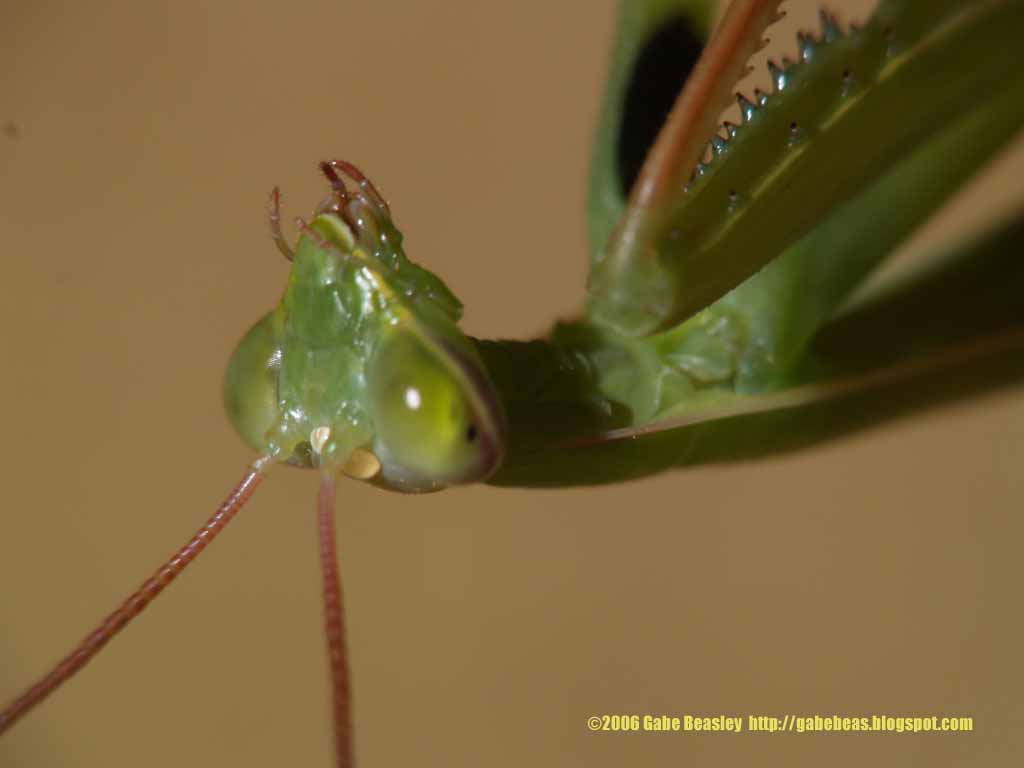
Here 5 eyes are visible. As wasps, bees and most other insects have--the two main eyes see very well--but an extra 3 "simple eyes" are probably there for orientation. By knowing where the sun is and other light positions, these eyes can warn of an impending shadow of doom or survey as a guide from the sun. These eyes are not much more then motion and light detectors--but they are highly developed here so they are probably needed. There are still many mysteries about insects which have not been solved. This topic is one I need to look up.

MORE ON "READING INSECTS"
I know her from her slight actions and posture and thus can usually forecast both how she feels and if she is planning something (like flying away). The same is true with bees, wasps, and spiders. I can move an orb weaver to any part of the web I want--send her to her hideout for some good shots--bring her back out--and back again. I did a demonstration of this and everybody thought it was awesome. No magic, and no I am not talking supernatural stuff. I just know how they react to certain things by touching the web in the right way. Temperament experience is necessary here. I still have allot of learning to do with many more species. This is a case of it looks very easy but without the right knowledge it could end in disaster for the praying mantis. If you keep one as a pet--read stuff about them and treat them with very delicate hands. There are books on line that I have seen and some petstores sell them as pets. How to "read insects" and spiders is something I picked up after years of experience. It is like reading any other animal, like reptiles, dogs or dangerous fish. It takes a great deal of time to get to know how to handle dangerous insects and most of all know how to handle insects without hurting THEM. They praying mantis is NOT DANGEROUS. Humans unknowingly harm many kinds of insects simply because they are fragile and we are so large. Keep that in mind.
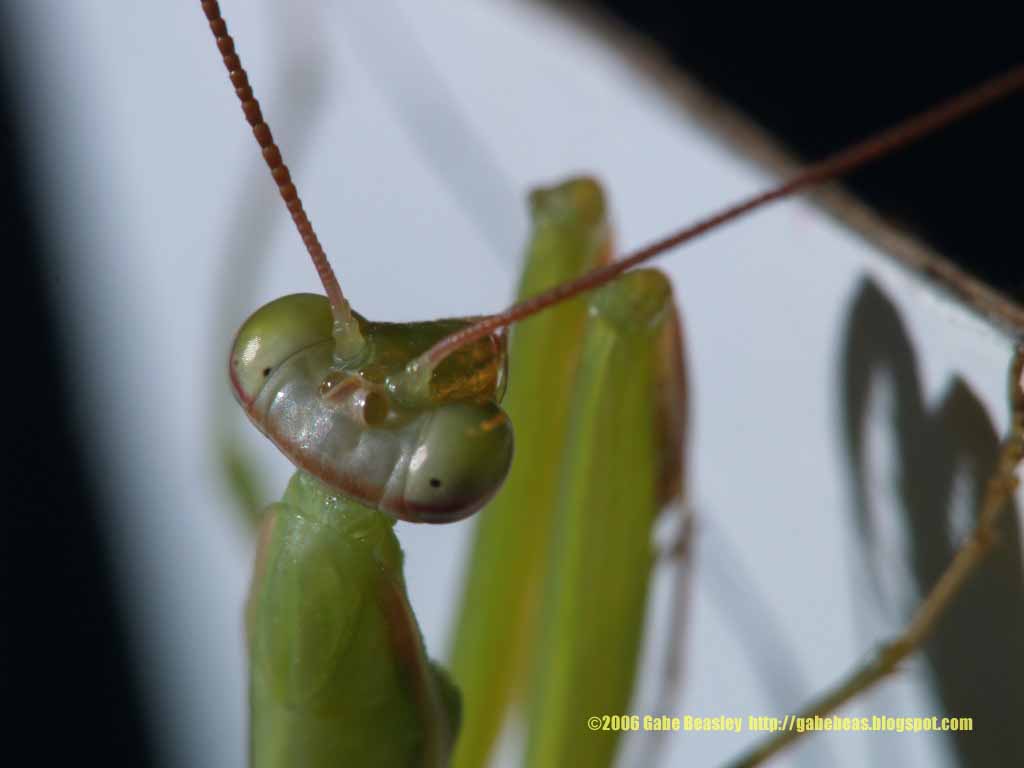


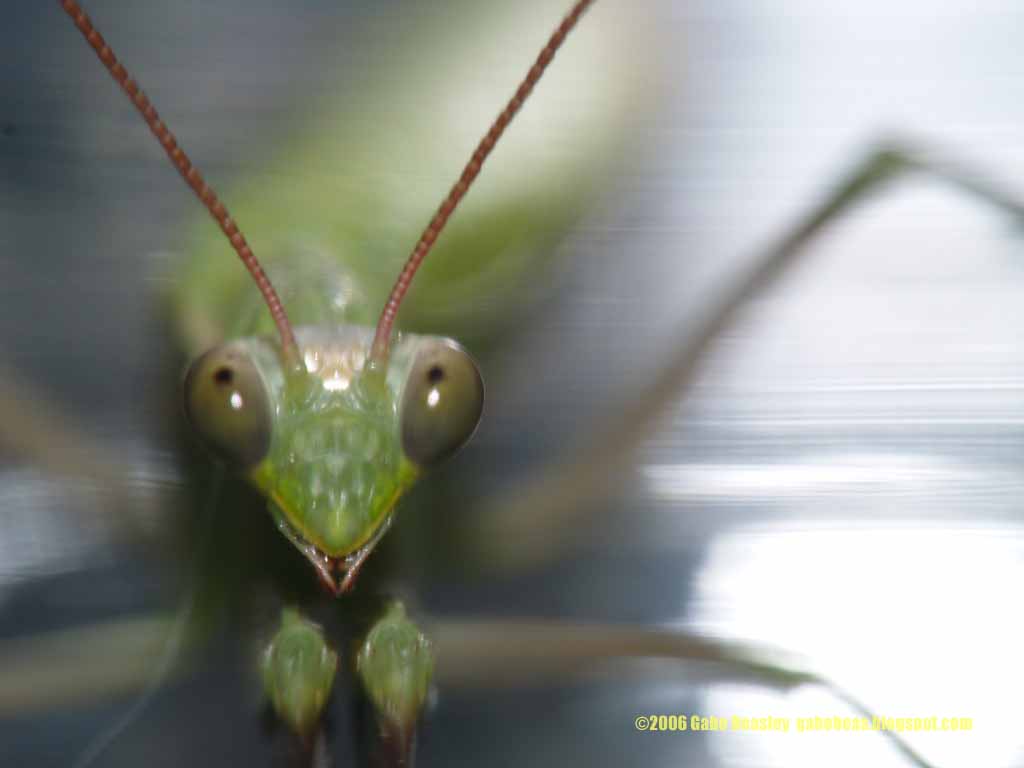
"I can see you, what do you want, what do you want?! what do you WANT!"

HANDLEING INSECTS

With most insects however, we are far more dangerous to them then they are to us. We simply don't know our own strength and just a small squeeze can break there limbs or cause bleeding and harm them in internal other ways. Insects and spiders are very fragile creatures to us-bite and sting is a very last resort.--you have to be extremely gentle with them. NEVER use tweezers on a living insect--they almost always break and cut off legs or even cause internal injuries that will kill the insect you are trying to catch. Just a slight squeeze is all that is needed to break off a leg or a wing or crush the body of an insect. When picking up an insect you should just be sure that it can handle it. Be very very gentle, and watch it's responce. The praying mantis will at first try to do nothing but fly away (after it's adult molt stage). Getting experence about this stuff can be helpful but if there is only one way to get it then start gentle and read as much as you can. There are books on keeping a praying mantis as a pet, or a cricket, or other species. The basics are not to harshly react if they bite or attack you--that quick reaction could kill the insect if your not ready. Then when picking them up only hold them by there body--never by one leg or a number of legs. Hold only tight enough to hardly keep it between two fingers--very gently. Get a feel for that. After a while a praying mantis will begin to trust you. They are smart and are capable of realizeing that people are not a threat (more or less).

There are just allot of things you have to be taught by mentors and or hard-experience over the years because you had to learn a lesson the hard and painful way if you did what I mostly did. If I had not got some mentor help--I would not be able to do allot of the stuff I can do with spiders and insects now. Yah, that dreaded feeling of guilt is difficult when I hurt or kill an insect by accident. It still happens. I just never gave up and persisted my interest until I found out series knowledge about how to hanldle both dangerous and fragile species. I am not good enough a writer to put together a book on handling insects--but there are lots of good books out there---if you want to know how not to hurt insect and spider pets--there may be some books available. Knowing an animal well is to put yourself in the mind and idea of being that small of a subject.
E-mail me from this site if you want any tips--I don't mind and enjoy hearing from other people interested in Photography, insects and spiders. Don't forget a got alot of pictures to post--but recently I have been into the bugs for summer.


Different positions of a flash can bring out different colors and different angles of view.

WHEN HANDLEING INSECTS
Let them do the walking and learn there expressions. Don't fear but RESPECT there space. People often think it's just an phony ego trip to say "I have years of experience, don't try this at home"-- Like in those popular reptile hunter TV shows. They very rarely get bit if ever because they know what they are doing. People see those shows, often drink a few beers (or not) and go "there's nothing to that--I can catch two snakes--take my picture.." Not listening to that notice and fact that experience and training is very required when it comes to dangerous animals of any kind. And it's no ego trip to say "don't try this at home". As I often see on the Discovery Health channel, with rattle snakes--that advice is not respected and it often ends with a dead snake and a very sick and humbled victim with endless medical bills and a new opinion about respecting wildlife and the people in the know. Those kinds of notices have a serious point. Handleing taratuals in the wild for example is something not even I would do without a bit of reserch to brush up on it and some special gear. You must allways remember it's not just yourself it's the animal you are catching. You have to make sure neither of them get hurt. I prefur photography because so often I can take pictures without having to interfere in any way with the subjects I photograph.
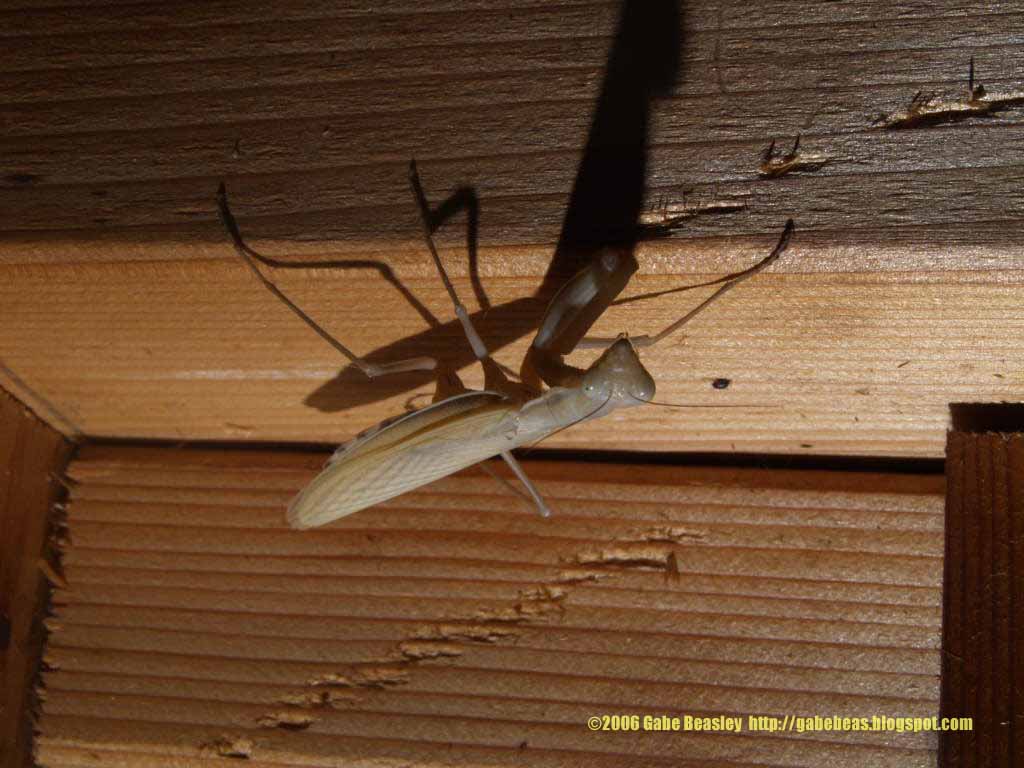


Another lighting angle. This is another praying mantis, I found two on my pourch. A friend found one of them and I found the other. I was able to take this picture with a digital wildlife lens from about 6 to 8 feet away. (300mm equiv. 35mm).

"Night stalk"

This picture was not shot in Sepia. It is just a very low light shot. A praying mantis can get lost behind a dryer or oven. You probably don't want that nightmare. Be careful about any choices you make with insects or any other wild animal. I had to get bit my a chipmunk before I learned not to grab them. And by a rattle snake before learning it's just not a very good idea to have one as a pet, especially if captured from wild. So taking all the blows and bites I have -I have been very LUCKY. Most insects and spiders are not dangerous but can quickly be hurt by handling. Holding a butterfly or moth will literally remove it's scales like feathers off a bird. They do not grow back, and the butterfly or moth will soon be unable to fly and die. There are many things to get to know about insects and spiders as well as just handling them for pictures or fun--if you have any questions--e-mail me and I will get back to you when I can. I don't mind because I want to show people the facts about insects and spiders so that we need not fear them, we can and should just learn to understand and respect them.

Saturday, August 12, 2006

CLOSE UP-- "BULLY BEES"

PLEASE DON'T MISS MY AMTRAK SHOTS, INCLUDEING HARD TO GET DEER SHOTS=BELOW THIS POST=NEW AS OF 8/17/2006


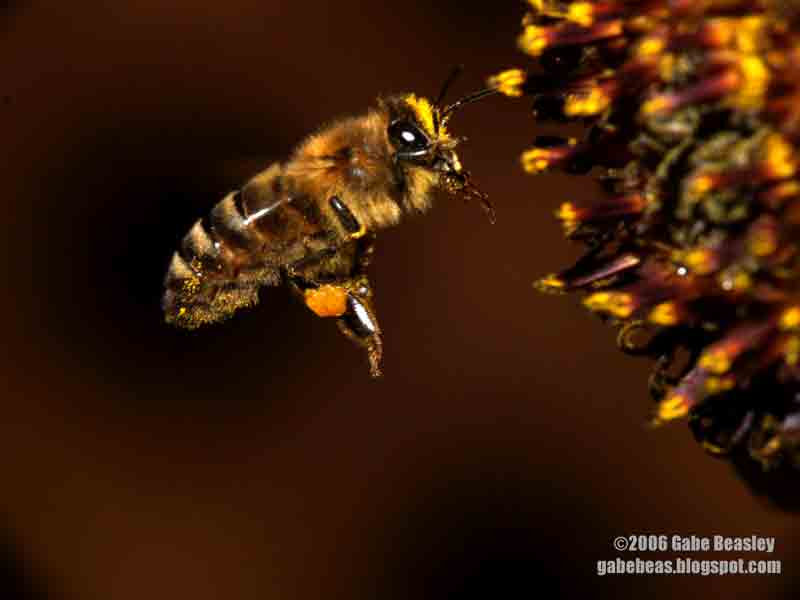
"Highlight"

A honey bee, in flight. This is just be beginning of a series and sequences of shots I have been taking this summer. Sorry about the long wait! I have had to completely re-do my file system and backup literally 100s of CDs. All this work and way to many pictures caused me to switch to RAW, which has given me new abilities and new knowledge. Someday I wish to be pro, I have the power to learn how to shoot like one and I got to start somewhere. The advantages also outwaigh the problems. I got allot of pictures here and allot of words I wrote after not sleeping for a couple of days--non-stop to get this published. Finally I'm getting these pictures on line. I thought about publishing them with no words at all--but I should be able to find some middle ground to describe what I have observed. As you will see, this is important.
CLICK ON PICTURES FOR LARGER VIEW <-- TO get back to my site.

PLEASE DON'T MISS MY AMTRAK SHOTS, INCLUDEING HARD TO GET DEER SHOTS=BELOW THIS POST=NEW AS OF 8/14/2006
NEW SHOTS ADDED-8/17/2006--THE ACTUAL TAKEDOWN OF A BEETLE

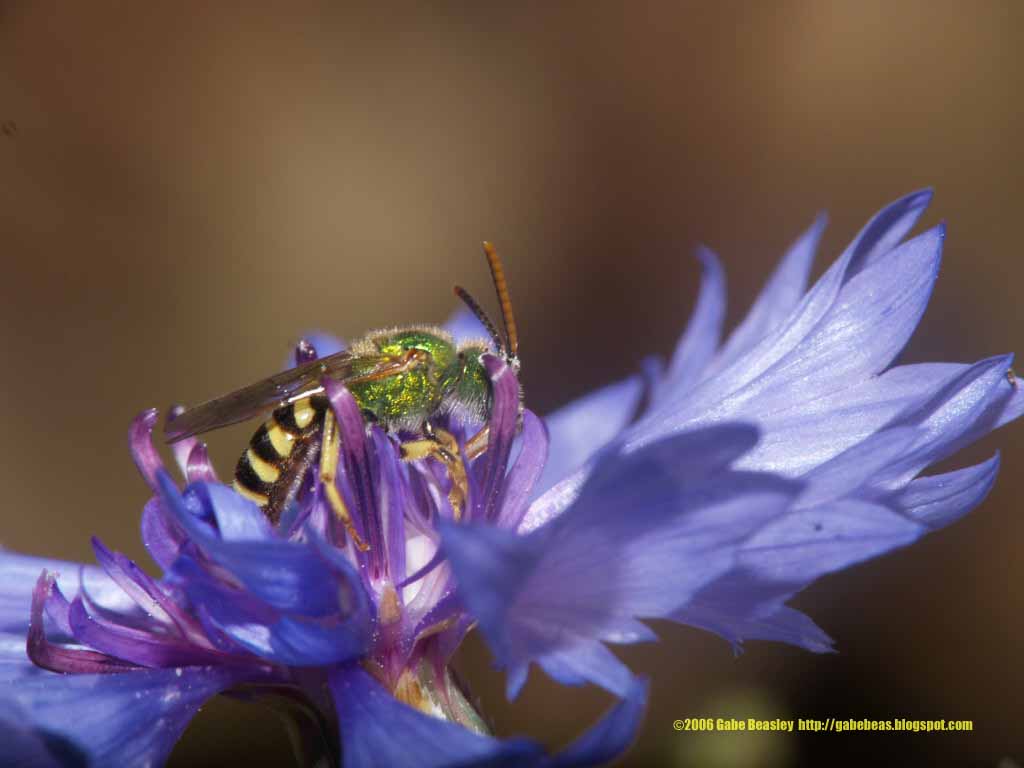
THIS IS THE COMMON GREENISH-GOLD SWEAT BEE
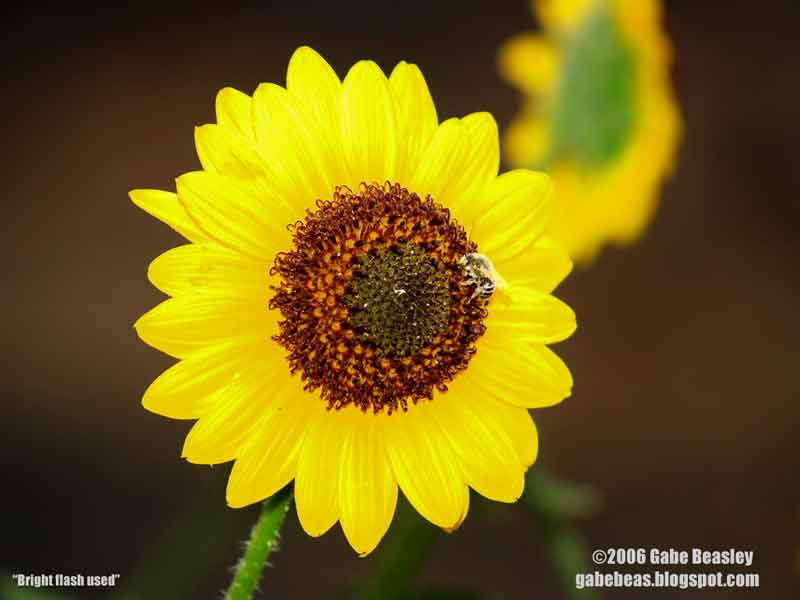
These shots were a bit of luck and a bit of new-learned lighting techniques. I am learning more and more about lighting and camera settings. As soon as I think I know something well you realize that you are such a beginner. In some ways that‘s what I like about photography. There is no end to things to learn. I hear old-timers who have done this for 50 years and still learn new many new things today. It is a dynamic art and science as much as it is static. That is what I love about it.. Sometimes I forget things more then I used too, but I am still determined to get better and what I do and how I take pictures. THE BACKGROND to this picture IS REAL AND WAS NOT ADDED--it's all about your F-stop. Learn how to use it and you won't need to spend so much time in Photoshop. I'm no pro--but I got some experience now.


There are no intended insects in this shot.
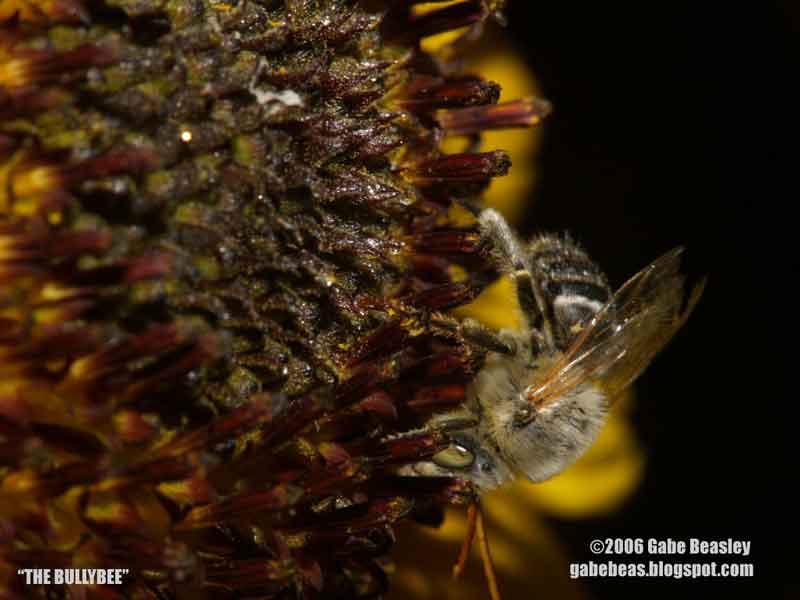
"Bully Bees"
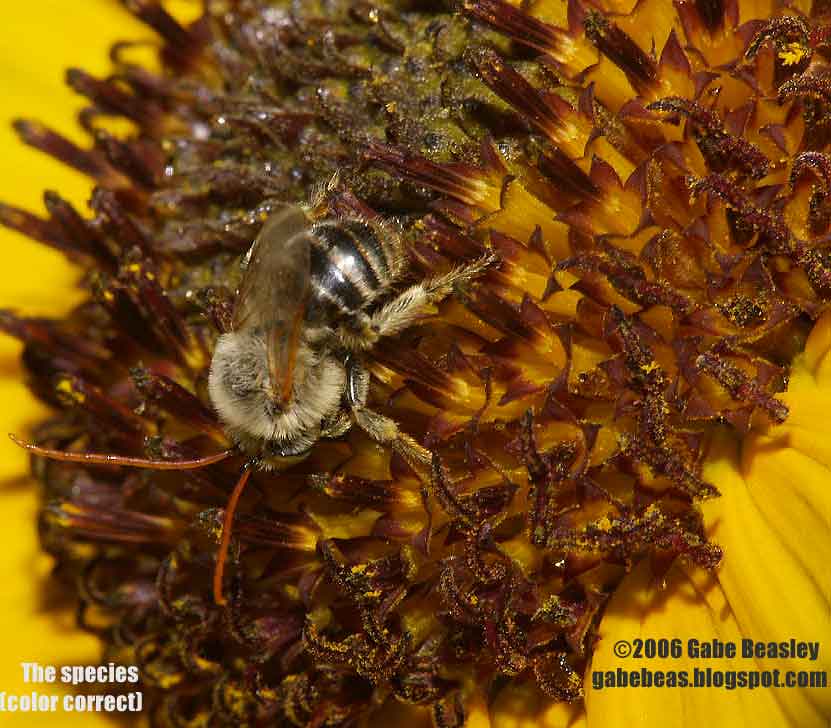
I decided to photograph and document the actions of a small semi-large sweat bee new to myself and my photography in The Dalles. A local bee I have been tracking that I have dubbed the "bully bee" because of it's aggression towards it's own kind and other insects. But that aggression stops in a very bizarre way---as you will see. Some lucky shots have let me be able to actually prove it! The beetle and bee caught by my digital SLR right on time shows the attack in progress. Like a tackle in football--the bee body slams into it's victim and then falls with it nearly to the ground recovering. All of this sometimes in less then a second. Each it’s a game. In lighting speed it flies up to the flower it had targeted and removed the competition from and gut’s its' reward--only to possibly be toppled by another one of these gray robust bees. These are mostly all color-matched accurate files. Only the lady bug shots are off a big in white balance. Most of these shots were not taken with any Photoshop or other modifications accept a bit of levels here and there and pinning my auto-stamped name and Copyright. The greatest thing here is a was able to capture these actions as they happened. I have science right here. Showing this. I plan to study more as long as this incredible sunflower continues to attracted insects. Here is is--there are better pictures of this "bully bee" below--but it can be quickly picked out by how fuzzy it is. Especially in this overexposure. Click on picture for larger View.


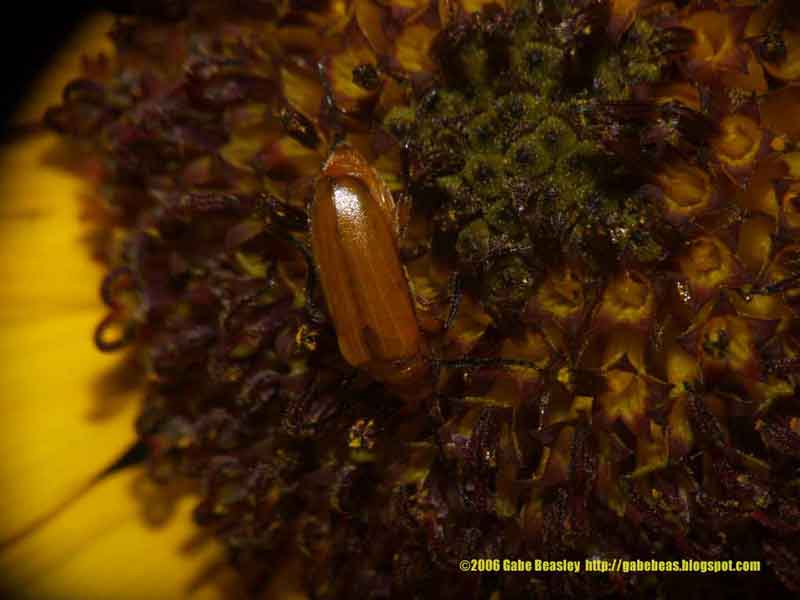
A beetle found often on sunflowers. You will see this poor guy get hit by an attack from a bully bee--looking!

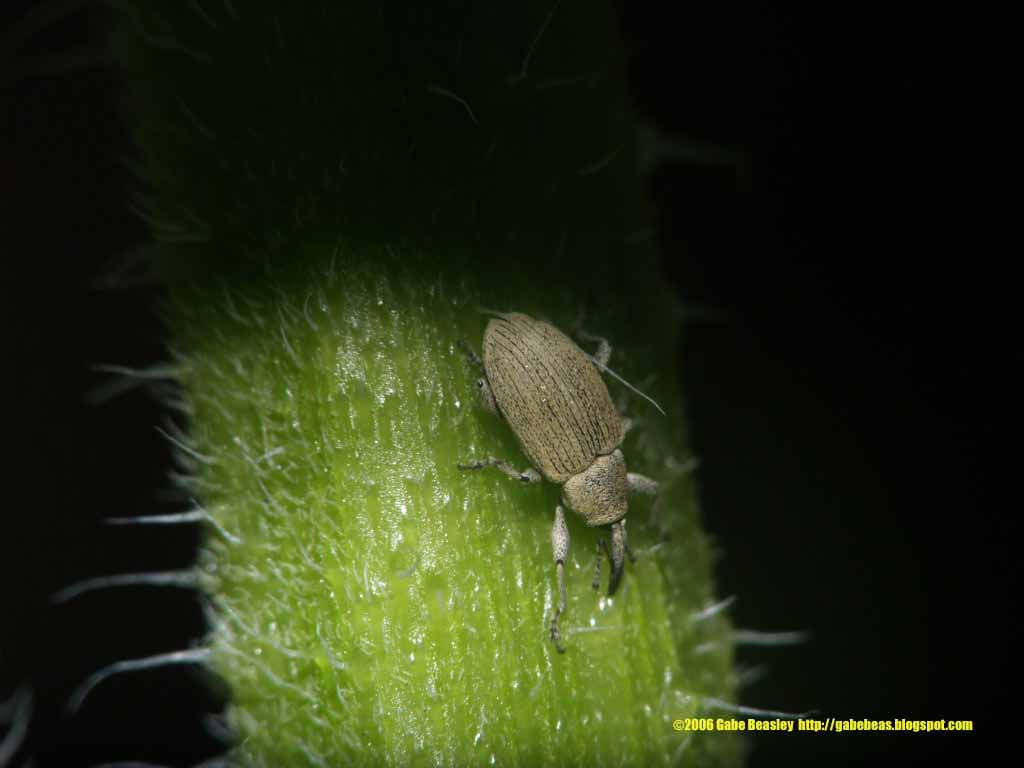
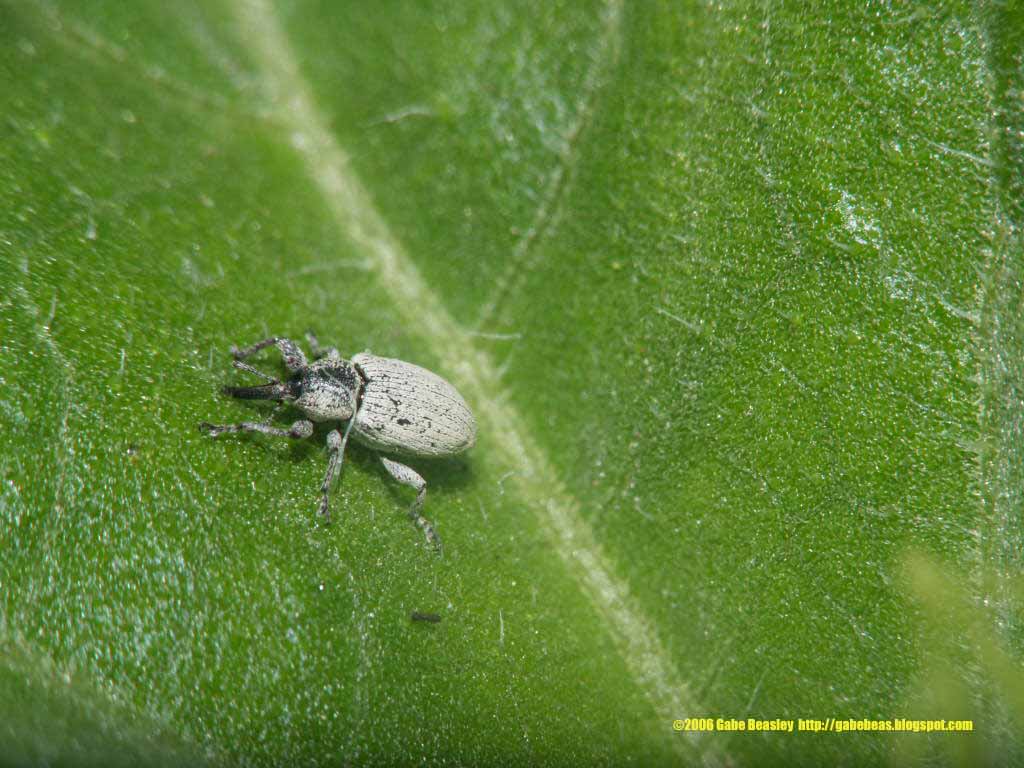
These tiny weaves are only about 2mm long. Probably the smallest beetles I have ever photographed.


What's this? Keep looking at the pictures and see!


I HAVE NAMED THESE BEES "Bully bees" for how they treat there peers and other insects sometimes. IT SHOULD BE NOTED I made this name up myself because I can't find a name. It is one of 100s of species of bees called "sweat bees” I will tell get you the true name (if they have one) when and when I can. Until then they are just another kind of sweat bee. Many sweat bees exhibit similar behavior with there own kind. I have just not ever seen a species this aggressive, especially towards other insects.

I hope you enjoy these pictures as much as I do. To me flowers are usually a bit dull unless I win some points with the ladies with them! But they come alive when I see one with complex living insects on them. This combination is not only my favorite but also seems to sell me the most pictures. Flowers or green foliage pictures are everywhere--but good insect shots on them are not. I still photograph flowers alone, but they often need the incredible power they have over insects to be there greatest. I am fascinated by this ability flowers have to bring the incredible world of insects and spiders alive. I'm into bugs and photography of nearly all kinds now. So flower shots I have to ask my mom about. I am going to try to grow my own by next year. Simple ones that target insects and butterflies. It would be a great advantage to not have to risk trespassing, dogs and shotguns like I often do out here to get a good shot! The insect and thus spider possibilities have my blood pumping so much. So I think I will plant this garden for next spring and try to have some flowers of my own here more then just the regular weeds. I doubt they will live long because I deffinately don't have a green thumb but it can't hurt to try.

It's taken me over 14 hours of nearly non-stop work to bring you these pictures. It is ALLOT of work for me to get things right to be posted. I know--I write to much, but this compulsion is hard to control and I like to describe things. Very quickly this can get out of control and I forget to check all spelling and other things. PLEASE FORGIVE these errors. On average I am on line for 2 hours per picture.


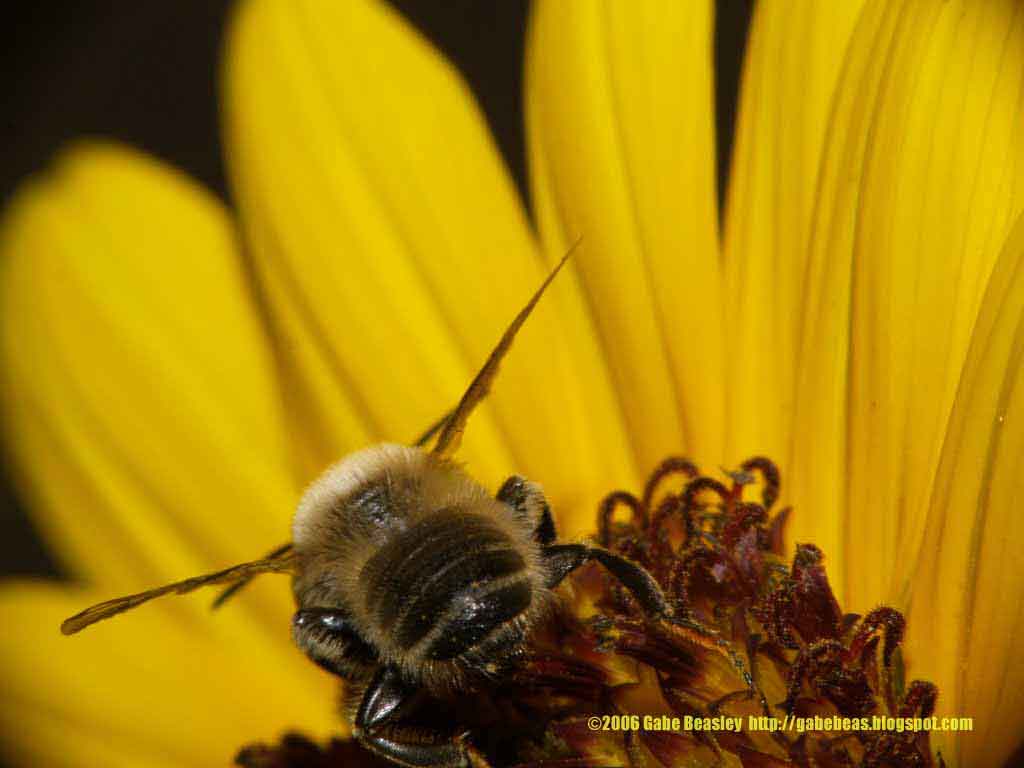
The "bully bee". At least that is what I call it now. See how fat she is, you will notice the clear difference between other sweat bees I photographed this year and last.

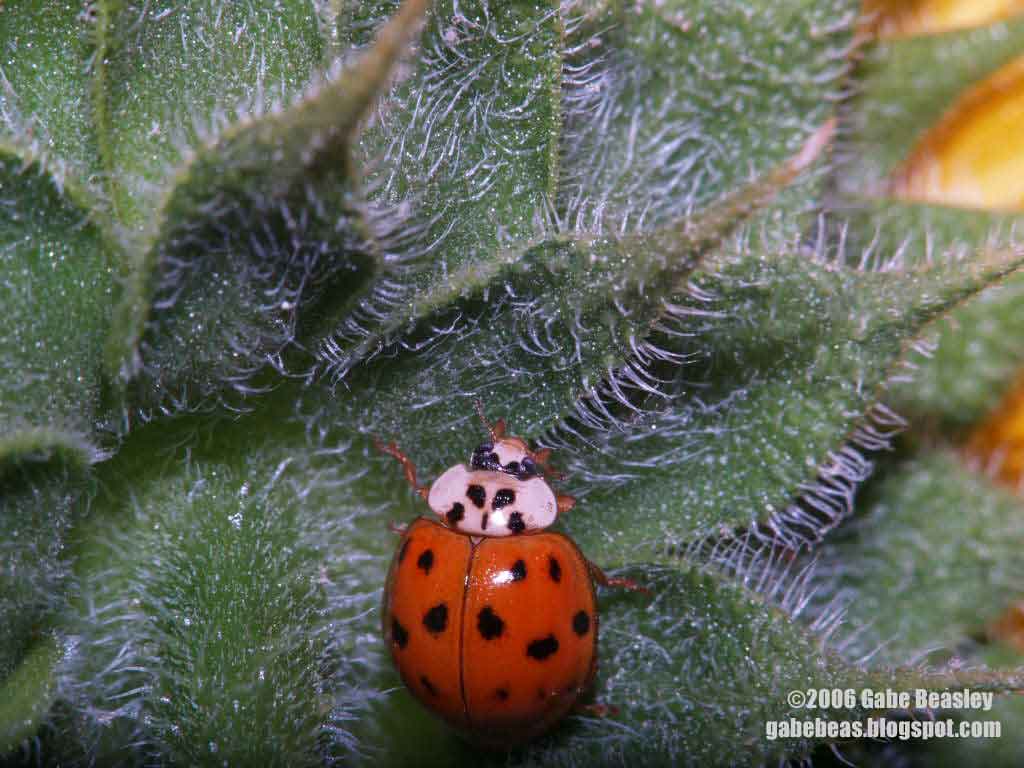
Ladybug walks on the underside of a bud.
Here is one kind of sweat bee that I have seen compete by wrestling in the same way but only very rarely and for small flowers that are too large for two bees. So they are nothing in aggression like the "bully bees" as I have named them--which are clearly another species.


Another iridescent green-golden bee showing some size perspective. These are not typical huge sunflowers. They are not even as large as my outstretched hand. It will tolerate other occupants unless the flower is very small or very over crowded in which case this species attacks as well. Smashing into each other--I have a really good example of this on my wall. The "digital negative" is buried so deep in CDs I can't bring it back here without allot of work but if you go back in my website to last year you should find it in one of the summer months. Click for a slightly better view. USE < -- to get back to my website (your browsers back arrow) Here it is with that look "I’m going to kick your a--!" in it's eyes. These guys don't care how big the flower is---while buzzing around so fast I don't know how it can see anything, this one huge flower is not big enough for two of them. This one would be knocked down quickly if another one locked on to this flower. Face on--this high-macro shot is one of the best resolution shots I have. It is also definitely color correct. As most of my pictures are. I spend time to set my white balance right (usually).
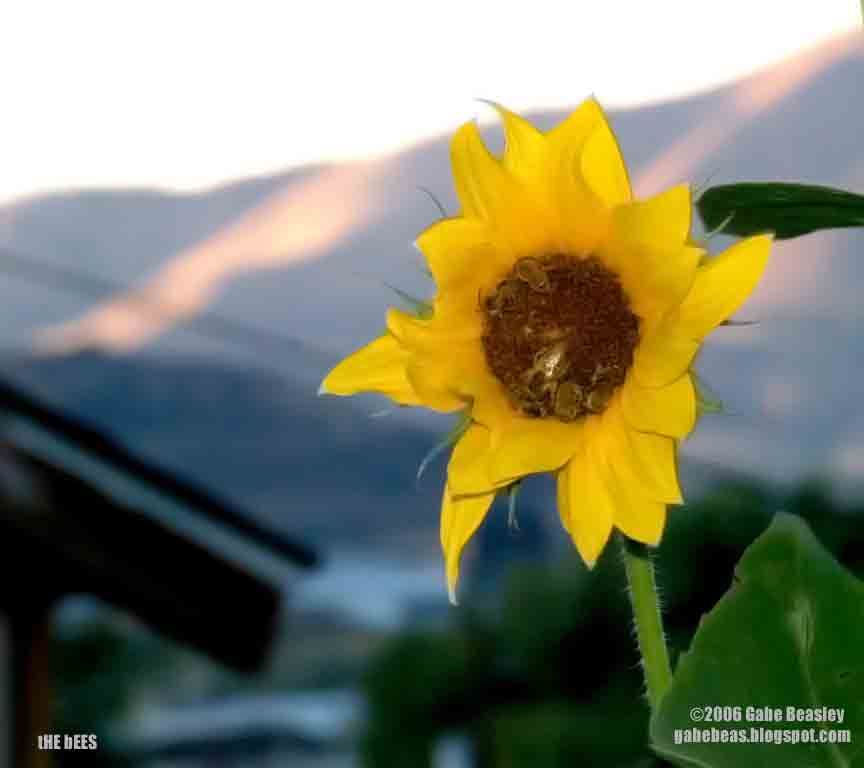


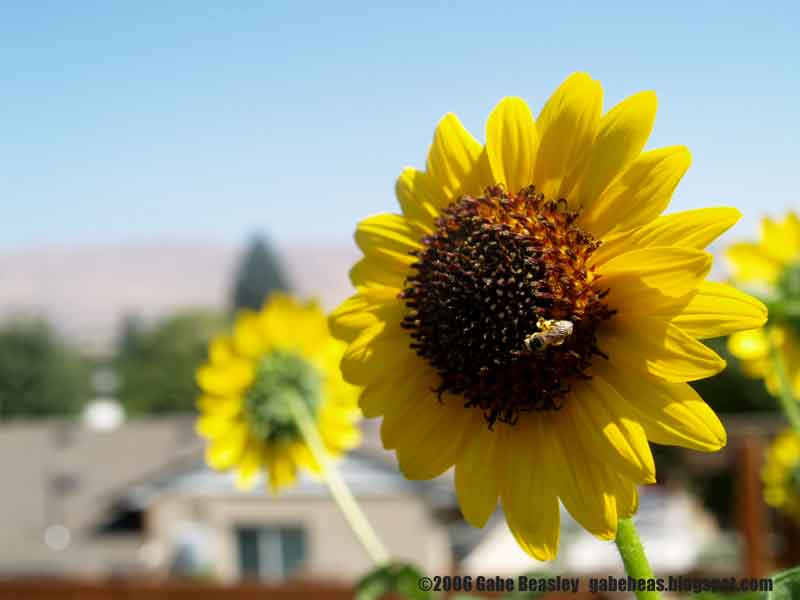
This is a view of the Hills over on the Washington Side. On the Sunflower, is a small red Beetle.
Watch what happens to it.

THE ATTACK!
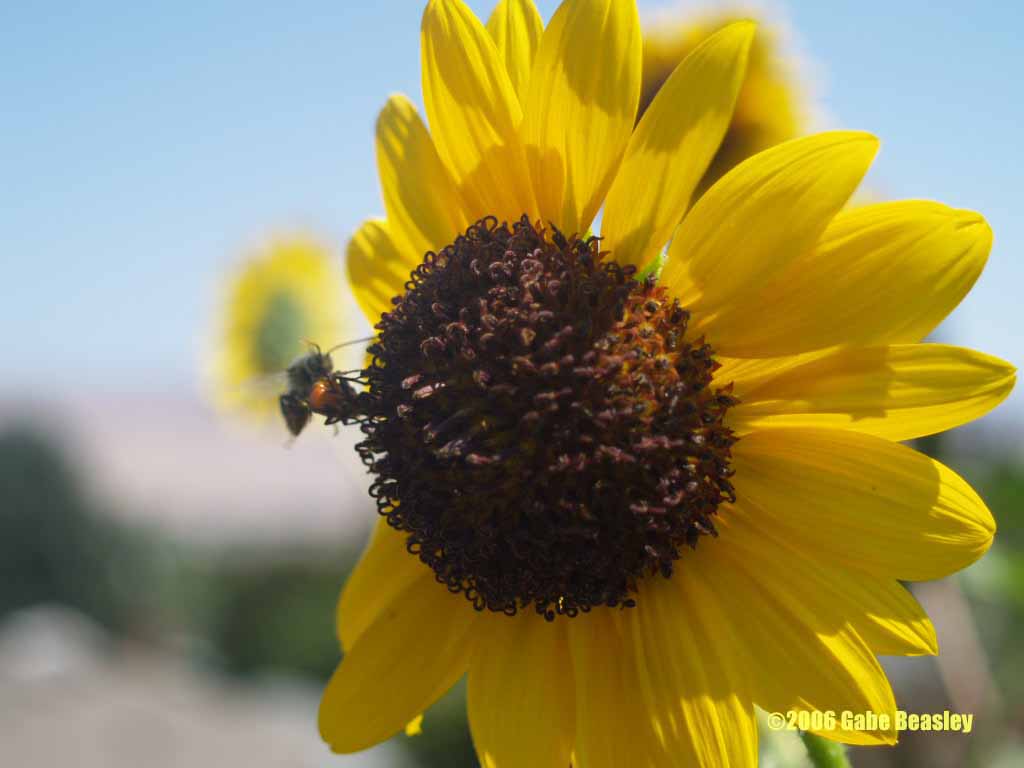
The red beetle, shown in other pictures--as it is about to be knocked off the flower by this bee dive bomber. My observations show that they do not sting when they do this--but just use the force of there bodies. Incredibly they often get into fights as they fall down together (something I have not yet been able to photograph) but yet come out of it fine. A sting or bad bite from another bee would probably cause serious damage. I doubt they sting or even bite because this would be dangerous if not fatal to there own kind and a waste of valuable protein. And each one of these bees I have seen through my macro lens or photographed is not hurt or dammaged. No battle scars like the ones you seen other types of bees sometimes. Here is the next best frame I have pushing my digital SLR to it's limits--this is all completely over in I'd guess less then 1/2 second. This was even faster.


THE TACKLE and this is when it gets very exiting. These are the bees frames. This is the same picture of the same beetle and bee and the incident happened so quickly it takes a digital SLR to get the shot. As you can see the bee hits the beetle and seems to be grabbing it. The interesting thing about this attack is not that this flower has lots of space and the bee is being a true "jerk". It is very interesting that the beetle seems to be unharmed.

It landed on another flower and I watched and photographed it again. The same way when they attack each other. Since there are not dead beetles or bees on the ground here it seems they are normally do not use a sting or dangerous bites--it's more of a wrestling match. And they do not seem to attack other types of bees, probably because of the real danger they will not know this game and get hurt? I am just putting simple observations here. This is admittedly a very amateur study--but no less interesting.


COUGHT IN THE TACKLE GAME
Here they are. In a moment captured by pure luck. The bee is comming in hot and fast--I had no idea and was only trying to get a shot of the single bee (the one on the flower) when at the exact moment at increible speed the tackle happened right in front of me! My shutter speed was very high. The attacking bee is marked with an arrow "The attack" This was cool--and I got a picture of it! You can see how the other bee is aimed at the one on the flower. This honestly was not camera skill--it was pure luck, and is nice proff of what I observed happening regularly. I still ask the question? Why do they do this?

Me having not seen them attack any other species of bee or wasp may just have been chance, but a venture a guess that the actions of tackling relitively harmless insects and the idea of going at it with another species of larger or even smaller more agressive bees--would cause them to look for warnings and not pick a fight with the wrong bug. For example--I never have seen them attack honey bees--honey bees are much larger. These bees are only 1/2 the size of a honey bee. And I never watched them hit smaller sweat bees which are easy to see by color are very different. They seem to be able to know at least for the most part what they are picking a fight with--but this is all pure amatur speculation.

This kind of bee seems to have to be "king of the flower" and unless in the state illitrated below, they will be very difficult to photograph. In the normal state of mind they will fly about drinking necktor for only about 2-10sec on each flower it goes to or steals from another bee, often until it gets toppled by another bee! And they spook at the first sign of me or a big camera. They seem to pick out flowers when they see thier own kind, or other insects like that beetle, and close in for the tackle. I still can't help but ask what for? Do they think that an occupied flower will have the best nektar? Or is it actually some kind of a game they play all day in the sun?
I find that impossible to beleave insects are playing games, but why would they do this only to turn completely dosile twards there own kind AND EVEN ME. It seems more a waste of energy to do these fights.

It is best to do short bursts of high-speed shots when you are close-at macro levesl this high, just a breeze can bring the subject out of focus. You can get 5 and then 10sec--and finally I got a shot like the few single-bee shots here at the moment before they takeoff. It takes ALLOT of effort and I have to be very sneeky about it when I photograph them as they go from flower to flower. Carefully approching them, litteraly not looking them in the eyes. Acting like a praying mantis. Being seemingly totally still and moving in close when they seem most distracted by the flower. I got less then a half dozen good shots out of nearly 100 of a single bee in the attack and active mode. I must have spent about a combined time of three to four hours there watching and taking pictures. On my last trip, Ready to walk away with some expected nice shots---on a gut-feeling I chose to look at the other plant and I found this! --this is the shock
of the year!

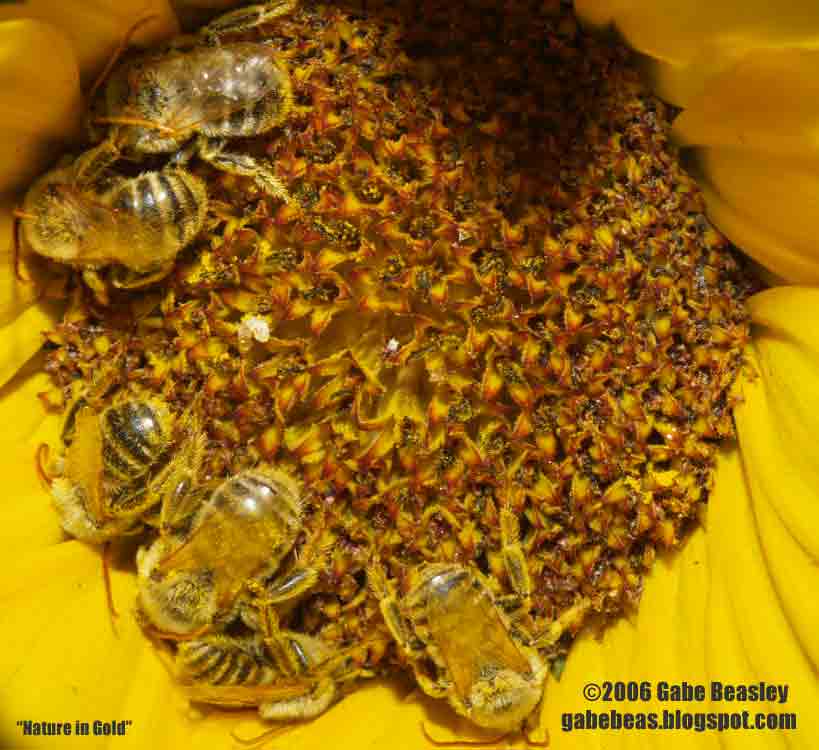
THE SAME BAD BEES! -First off, I know they are NOT mating or fighting or too cold. So with those things elinated then why do are they doing this!? Incredibly they become docile almost cuddly creatures quickly. Here seen covered in pollen. It is my guess that's because they are finished and full. Honey bees become docile under those conditions as well. Bee keepers use a smoker to get the bees to drink up there honey reserves leaving them almost drunk on sugars and thus far less aggressive. I theorize these bees are tired and getting some rest before taking flight to get to hives after feeding on the near by larger flower other larger sunflower bush.
If I recall, most sweat bees live in undergroud hives. They could be quite a long ways from home. Grouped together they are very passive and seemed not to notice me even when I got veryh close. Finding a couple of slightly secluded flowers like this shows more--they have a palce to hide in as these flowers were draped with dead folage and not easy to quickly see. Thier behavior completely changes. I observed and photographed them for at least another hour until sundown. Clearly as I say, they were not mating, or doing much of anything social except sitting there. The bee version of couch potatos.

Possibly they are drinking more nectar. Clearly they are part of a group of tolerations here I am nearly certain they were battleing eachother before this just as I documented but change when they get full or something. Honestly I need to look up more about how sweat bees usually live--but as I recall they are individually (like honeybees) unable to reproduce. Therefore they are all sterile-females and all from a hive with a queen or number of queens. I recall reading that they are less organized then honey bees but still follow some of the codes. Honey bees however to my knowledge--do not tackle each other like this except in the hive in rare deadly serious conditions.

You might think they are attacking bugs and bees because they are close to a hive--this is not probable as these pictures were not taken in a very good place for any kind of hives these bees could make. It is clear from other observations I made last year in another spot and where there are other sunflowers this year as well, that these "bully bees" keep up this kind of attitude no matter where the hive is. So it's not like hornets that attack everything alive to keep there hive safe. These bees are fighting each other but clearly stop and I'd bet that they are all from the same hive.

I've never seen this before let alone photographed it in action. I may never be able to get enough proof to say I photographed anything new or discovered a new behavior in sweat bees, I'm very sure I have not really found a new behavior. There are lots of qualified people who probably know all about this. And thus I am probably not the first to photographically document it, but sweat bee as "bullies" towards their own kind and even other insects and then being so paradoxically different later is if nothing else, a very interesting study in nature and photography. If given the chance, even in North America there are still countless insects and spiders we know little about. Any kind of study done is worth it especially to me. Learning how to observe and photograph animal behavior is one of my goals in photography. I am not limited to insects and spiders but they remain what I like to photograph the most.


This is the spot. Behind my place there is a back road and the neighbors setup a big sunflower plant. I found even more in another plant just out of view closer to the van.

SNUG AS A BUG IN AH---FLOWER?
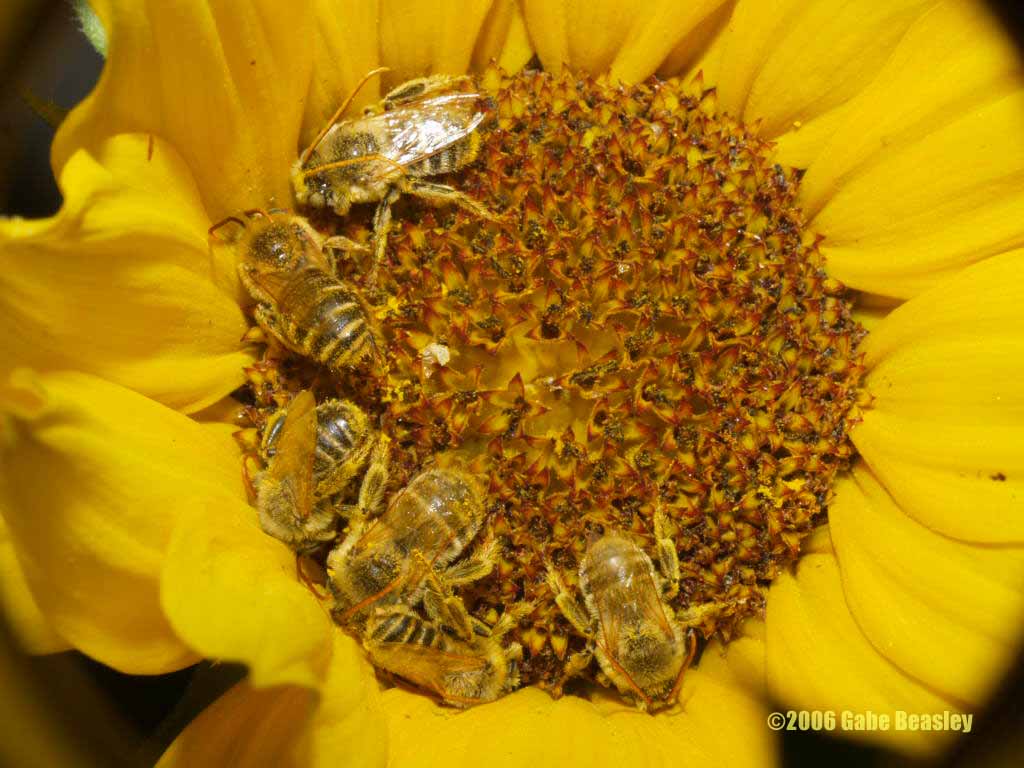
Once aggressive enemies while dog-fighting from flower to flower--these usually very hard to shoot bees are side by side snug and also un-afraid of me while I got as close as 6 inches for this shot. The flower was filled. The wind was blowing which may have something to do with this puzzle as to why they chose to do this rather then compete on the other plant with only open flowers. One of these flowers offered some shelter. The other's did not. What makes them aggressive to such a "king of the hill" degree over there--and so passive and tolerant to each other now. One OTHER THEORY I have is that we are dealing with a male and female sunflower here. And that the large amount of pollen indicates a male sunflower which provides the bees far more nectar then the female plant while covering them in pollen. If this is true--then they may be drinking there full here and hitting up the female sunflower for nectar only. I don't have a book on plants---research is needed to prove any of these theories.


Here was a great shot. No, I'm not kidding. This clearly shows the serious differences between the iridescent greenish-yellow nearly golden bees and these fatter furrier species I call "bully bees". I'm going to have to find there proper name--but they may just be another sweat bee without one. Notice the difference in line patterns and hairs when you see the other bees on my website.


THIS is the other common sweat bee. A big brighter yellow then last year? Na--probably my color settings on my camera. This iridescent bee may be one of two very similar species or just the same. Honey bees can have different colorations in some cases to a small degree. These "races" of bees are common in other insects as well. Slight variations are very common so I can't be sure. This bee also will knock off competing sweat bees of it's own species, but it's not as aggressive and I have never seen it be as serious as the slightly fatter and furrier species. The one's I call "bully bees".

The beetle harmlessly drinking nectar. Like other bees--it's evicted quickly by the "bully bee" but not by the other sweat bees who don't seem to care.


The sun goes down as I flash the flower very lightly. It's getting dark--are the bees going home like I am? I have many questions to answer. And a night vision video camera. Tonight?
I don't know---I've been up for about 3 days working on this--so forgive me if I made some errors in spelling and stuff here. Each block of text I have to run over to my word processor, spell-check it there--and then come back. The logger spell-check does not work on my system.


Some trick lighting created a new effect to know about. I have better examples for later posting.
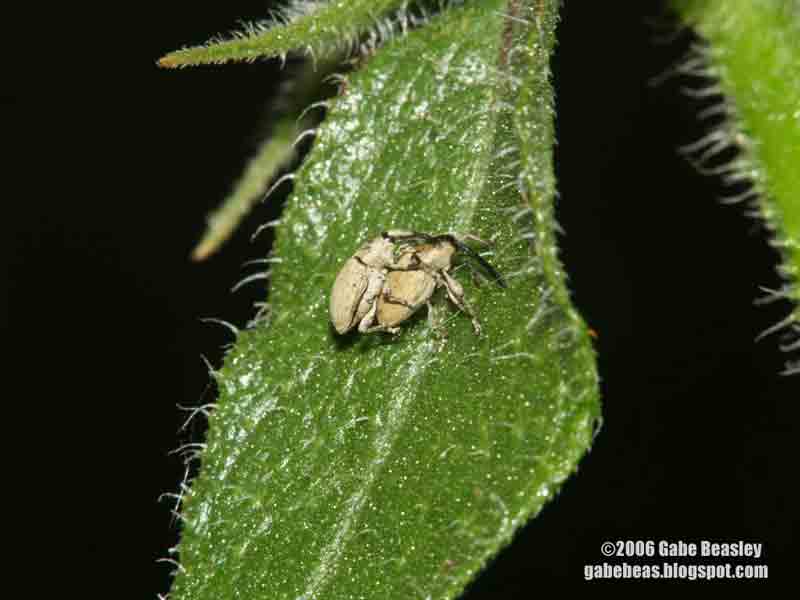
And a very small beetle, almost too small to see with the naked eye. I have allot of pictures to explain and show. Be sure to click on these for best view. This boll weevil is less then 2mm long.


The weevils feed by pushing there long mouthparts like a trunk into the plants veins to drain it of fluids. I am proud of this shot and the rigging on my digital SLR that I came up with to make it possible. I weighted my digital SLR down with a L clamp and then a tripod mount so you can use your chin to further stabilize the picture. I might think about a patent for this idea--but I am certain most digital SLRs will soon have that vibration control rendering such heavy stuff obsolete if someone allready has not invented the thing.


A typical green iridescent bee I shot yesterday.


A ladybug, just hanging out on the sunflower too.


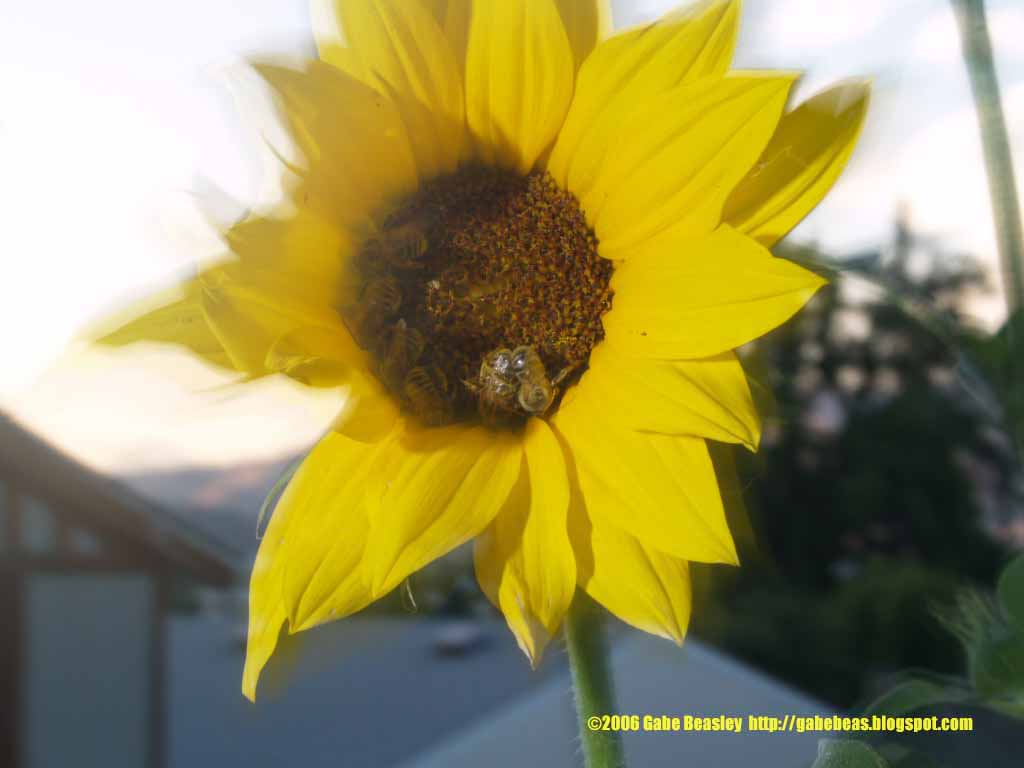
They are not that large. This picture makes them look bigger. They are only about as wide as my hand--even less. Not like the towering sunflowers we are all used too thinking about, and they all come up in the dozens form one plant.

Another iridescent bee--green-turned nearly golden by the pollen. Notice the colors--white and black. The size, and other things. The eyes give it away as a sweat bee--that is all.

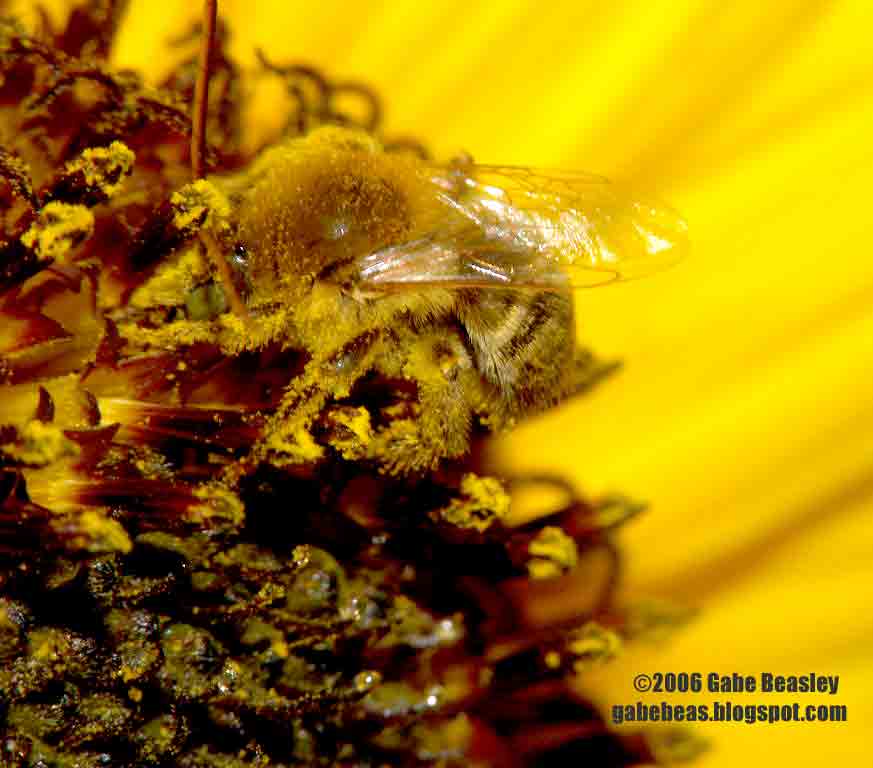
Notice the pollen sacks--this means this bee is definitely part of a hive. More on that later and can be found in my website back a few months.


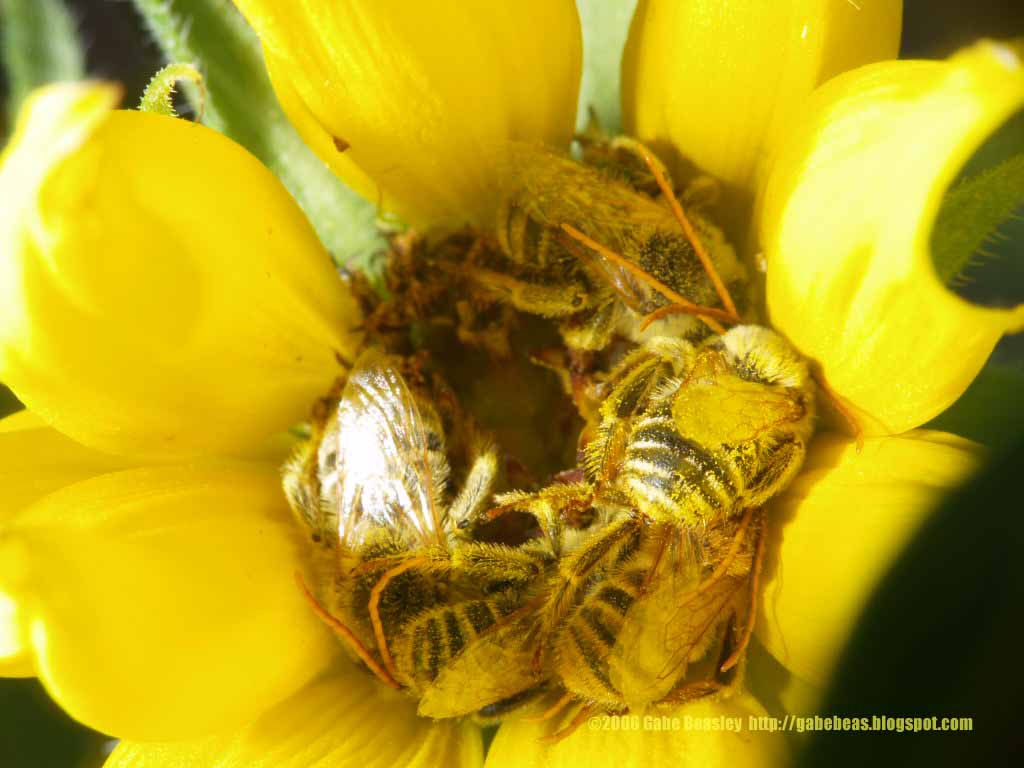
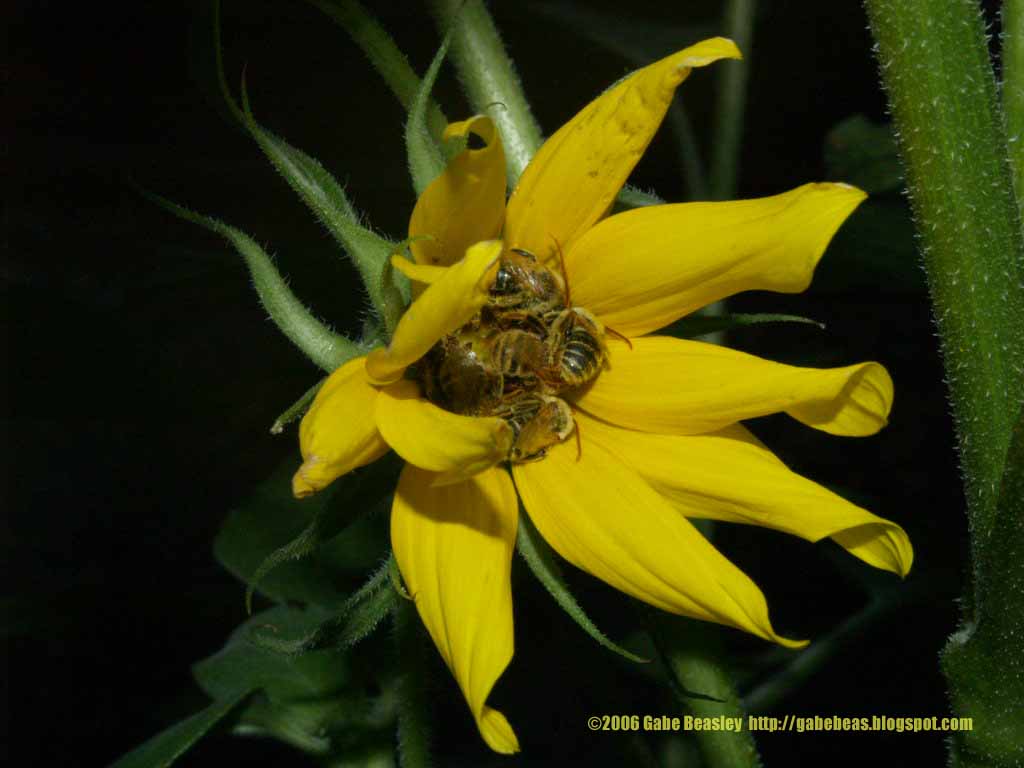
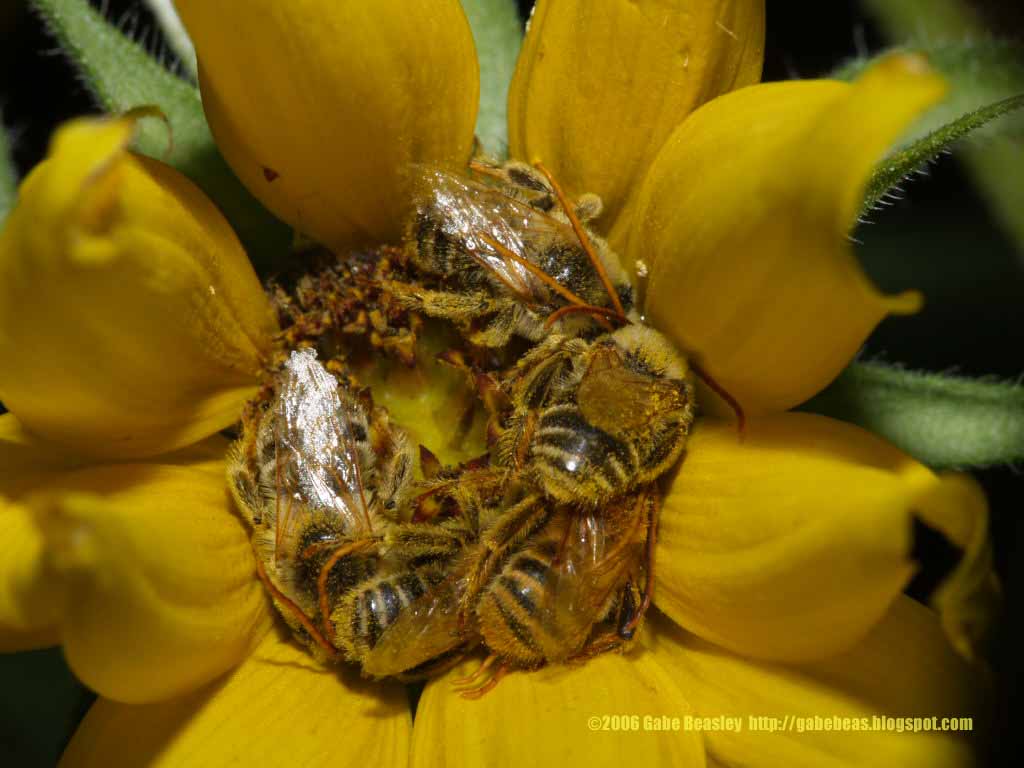
THE SAME BEES! - time of day AND they are NOT mating or fighting or too cold! Then why do are they doing this!? Incredibly they become docile almost cuddly creatures in hours. Here seen covered in pollen, probably because they are finished and full. Honey bees become docile under those conditions as well. Bee keepers use a smoker to get the bees to drink up there honey reserves leaving them almost drunk on sugars and thus far less aggressive. I theorize these bees are tired and getting some rest before taking flight to get home after feeding on the near by larger flower bush. Grouped together they are not as alert and thus not very afraid of me. Finding a couple of slightly secluded flowers like this to hide there behavior completely changes. I observed and photographed them for a few hours. Clearly as I say, they were not mating, or doing much of anything social except sitting there.

Possibly they are drinking more nectar. Clearly they are part of a group of toleration here. Honestly I need to look up more about how sweat bees usually live--but as I recall they are individually (like honeybees) unable to reproduce. Therefore they are all sterile-females and all from a hive with a queen or number of queens. I recall reading that they are less organized then honey bees but still follow some of the codes. Honey bees however to my knowledge--do not tackle each other like this.

You might think they are attacking bugs because they are close to a hive--this is not possible as where these pictures were taken is not a place for the kind of hives these bees make. (Often underground). It is clear from other observations I made last year in another spot and where there are other sunflowers this year as well, that these "bully bees" keep up this kind of attitude no matter where the hive is. So it's not like hornets that attack everything alive to keep there hive safe. These bees are fighting each other and likely all from the same hive.

I've never seen this before let alone photographed it in action. I may never be able to get enough proof to say I photographed anything new or discovered a new behavior in sweat bees, I'm very sure I have not really found a new behavior. And probably not the first to photographically document it, but sweat bee as "bullies" towards their own kind and even other insects and then being so paradoxically different later is if nothing else, a very interesting study in nature and photography.

Now they settle in as I carefully adjust my lighting to the sun as it goes down. Will they spend the night here? That might be--since there are many bats that fly by night, I just might have to go back with my night-vision camera and find out if they do this to give themselves a rest and be ready to fly in the morning when bats are not around. It's 130am--walking around with a video camera in night-vision mode into this person's back yard might get me into more trouble then I can handle--so for now I will call this off. But I plan tomorrow to go and check this out. If they are still huddled--when the sun is down I will go with night vision on Hi8 tapes and find out if they are waiting or leave before sundown. This would be another peace to the puzzle.


No matter how close I get they do not even notice me. When usually in order to capture a shot of a single bee--I have to be very quick and very patient. It often takes at least an hour to catch one. But when they are huddled--they seem to forget the outside world.


Why are they out of the game? Wind is high enough, but the others are buzzing. Why are these one's hiding here? And why is there behavior and temperament so much less serious when in this state? Why do they swarm and attack other insects and almost certainly there own rivals of the same hive? And then drop that attack mode--and get along like this?


Lighting changes don't matter.


Bee Donuts. Different lighting angles. As you can see they are pilled on top as if suckling from a mother. I have never seen anything like this in all my years of watching insects. And all this time I could have taken nearly perfect close ups here!


Why are they out of the game? Wind is high enough, but the others are buzzing. Why are these one's hiding here? And why is there behavior and temperament so much less serious when in this state? Why do they swarm and attack other insects and almost certainly there own rivals of the same hive? And then drop that attack mode--and get along like this?


It is getting darker--but not colder. I have yet to go out at night and check because this is not exactly my yard and I have never met the owners. This was a tricky shot for lighting and ballencing depth of field.

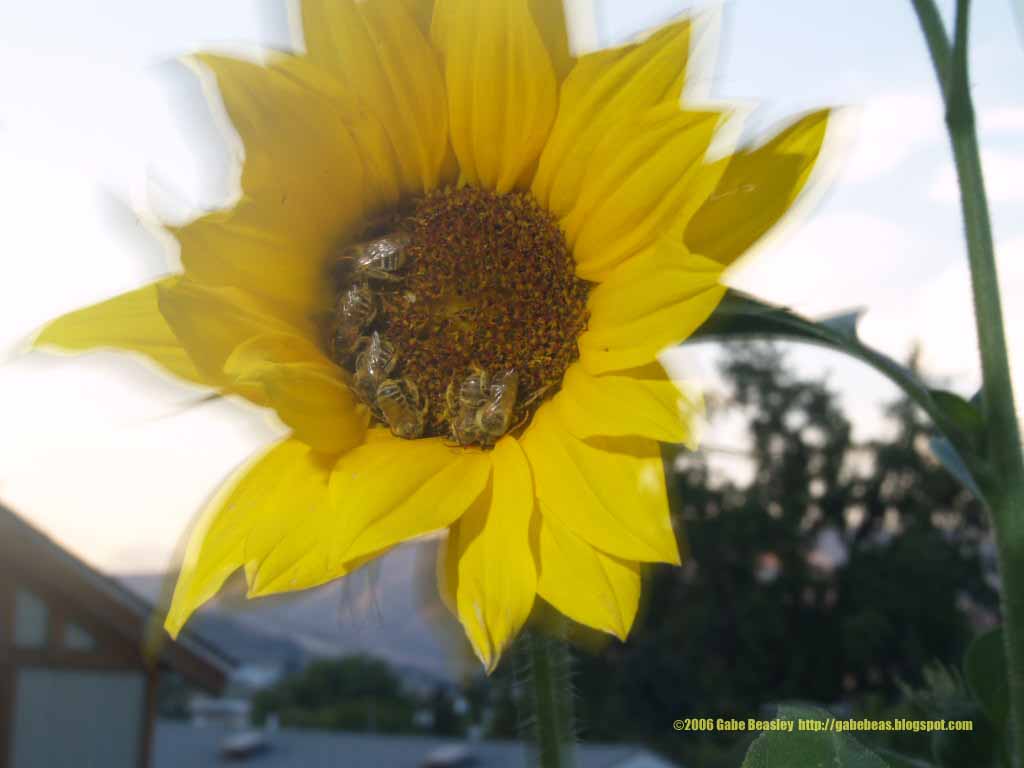
The communal huddle in a larger flower. Could there be something special about this flower or kind of Sunflower that produces this reaction?


The loan fighter. Maybe it's just getting started. But she seems to delight in attacking everything else on that flower. Especially other bees of her kind. Notice how she's not covered with Pollen yet. This has led me to believe that the bees turned docile in groups like the ones above this picture are full and resting as where this one has just arrived.


This is a lighting trick that sometimes just happens. In this case, I wanted to get the background lit and the bees in the flower as well. This is not a blended image, in fact, the only thing added or changed in this picture is my tiny (C) 2006 Gabe Beasley notice. This is an example of how an error can cause me to have to go to a great deal of trouble to fix. This time I will let it go. I got allot of work to do on my file system still and that is why I have not been posting pictures.


Here is a view of another one covered in polen. They are easy to tell from other sweat bees. The size of there abdomen and markings hold the key. These pint-sized sunflowers get most of the bees covered in polen until they nearly look as if they are in gold-dust. Incredible views made possible only by long waits. If I ever write a book on photography--the first rule I think I will put in it is the need for PASHENTS. I took a break and then tackled my database of pictures. 100s and 100s of CDs. I am glad I figured out a RAW + JPEG shooting mode that gets me what I want in my digital SLR.

THIS IS NOT THE END OF MY WEBSITE!
THERE ARE 100s MORE PICTURES TO SEE! MANY PEOPLE DON'T FIGURE THIS OUT. SEEING THE REST OF MY PICTURES HERE IS VERY SIMPLE, PLEASE READ HOW HERE!

Go to "all pictures" at the top of my website and click on each month starting with last month. Go up month by month and scroll down to the bottom until the very first month and you will have seen my entire website. I can't put 100s and 100s of pictures on one page or it would take days for even a fast computer to load my website. So I had to break it up into months. There are tons of pictures NOT ABOUT BUGS as well as articles. PLEASE DONT MISS IT--you will be glad you did not!